
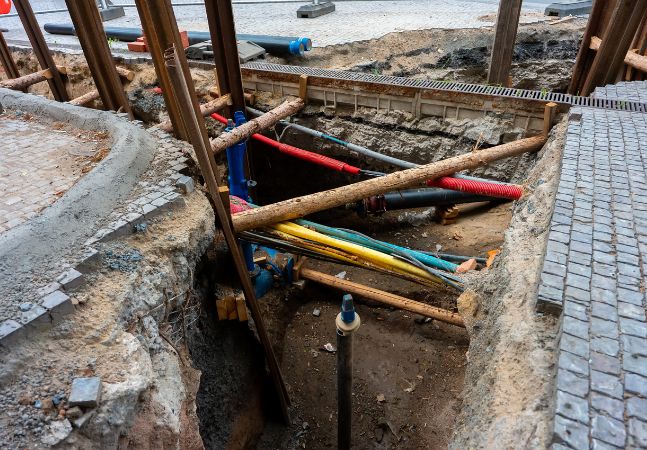
Underground Utility Damage Costs US Economy $83 Billion Annually
A Common Ground Alliance report shows indirect harms like business outages and project delays drive 94% of utility strike costs.
- By Jesse Jacobs
- August 17, 2026
Accidental damage to buried utility lines costs the U.S. economy an estimated $83.2 billion each year, according to a report released by the Common Ground Alliance.
The updated figure nearly triples a 2019 benchmark estimate of $30 billion. The increase reflects higher damage incident volumes along with a more comprehensive evaluation of downstream economic fallout when power, gas, communications, water or oil lines are struck during excavation.
Data modeled from 668,999 incident reports indicates that actual physical repair work accounts for only 5.9% of total financial losses, equal to $4.9 billion. For every dollar spent patching a physical pipe or cable, roughly $16 is lost to secondary consequences such as commercial outages, construction stalls, emergency response deployment, traffic detours and bodily injury.
Community and environmental impacts represent the largest single cost category at $32.6 billion, or 39.2% of the overall total. That figure covers public property restoration, facility disruptions and environmental cleanup. Direct business and economic productivity losses rank second at $31.6 billion, or 38%.
Operational response costs—including police, fire and regulatory compliance work—total $7.8 billion. Medical costs, lost wages and long-term disability stemming from injuries account for $6.2 billion.
The analysis comes as digging accelerates across the country to accommodate power grid modernization, broadband expansion, housing developments and data center construction.
The complete study, titled Between the Lines: The True Cost of Damage to America’s Buried Utilities, modeled costs across utility types, incident severity levels and geographic density using data from the Damage Information Reporting Tool alongside industry interviews and federal statistics.
About the Author
Jesse Jacobs is Assistant Editor of EPOnline.com.


