
Blog
Leaky Ducts Can Harm Indoor IAQ—Not Just Energy Efficiency – GreenBuildingAdvisor

Editor’s note: The following article by Allison Bailes originally appeared in Fine Homebuilding #265, March 2017. While many discussions about ductwork focus on wasted energy and comfort, this article explains why poorly designed or leaky duct systems can also affect indoor air quality, occupant health, and even combustion safety.
It’s well known that leaky, poorly designed duct systems cost their owners money and comfort in multiple ways. However, such systems can also make the air inside the houses unsafe to breathe. Indoor air quality (IAQ) doesn’t get nearly as much attention as other green-building concerns such as energy efficiency, but it should be one of the highest priorities for anyone who breathes air and spends time indoors. I grew up with really bad asthma, which was often triggered by indoor pollutants. I know the importance of good IAQ. I’ve also learned a good bit of building science and know that these issues are interconnected.
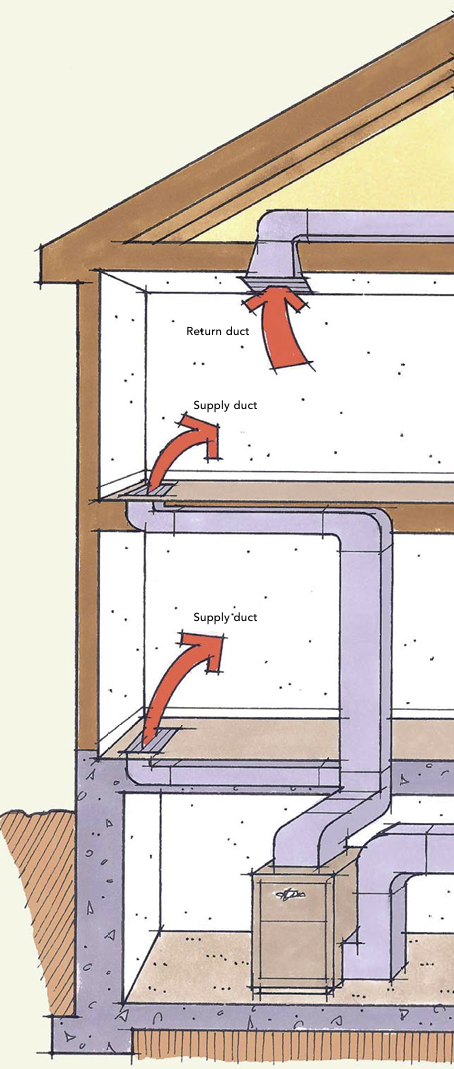
Ducts in forced-air heating-and cooling systems do one of two things: They either supply conditioned (heated or cooled) air to the house, or they return house air to be conditioned. Both supply and return ducts connect to the air handler, which is essentially a big fan. Supply ducts connect to the side of the air handler that blows air, so they’re under positive pressure. Between the air handler and the supply ducts is the furnace heat exchanger and/or the air conditioner’s or heat pump’s coils. Return ducts attach to the intake side of the air handler and run under negative pressure. Ideally, ducts should not leak. You also want them sized properly and installed well so that air moves through them efficiently. They should also be commissioned—that is, checked and adjusted at initial startup—by an expert to ensure that the system is balanced. In a balanced system, the same amount of air flows through the supply ducts as goes back through the return ducts.
It’s what’s in the air that matters. A disconnected return duct in most any crawlspace is bad news. In addition to sucking in mold and pesticide residue, this one spices the air with the aroma of dead possum (opening image).
If your duct system is leaky or unbalanced, air from spaces such as the attic, crawlspace, or garage is likely to find its way to your living areas. Think about what’s found in those places: insulation fibers, rodent and insect feces (cock roach feces are a major asthma trigger), mold, pesticides, radon, and fuel vapors. In one case, a HERS (home-energy rating system) company I work with, E3 Innovate in Nashville, Tenn., found a disconnected return duct sucking up air in a nasty, vented crawlspace. That’s bad enough by itself, but this particular crawlspace also had a dead possum lying close to that open return duct. Even the best filtration system would be hard pressed to remove that putrefaction from the air.
Ducts are a critical component in maintaining IAQ. When installing an HVAC system, you’d be much better off getting less-expensive, less-efficient equipment and spending extra to get the tightest, most balanced duct system you can. Your lungs and your overall health will benefit, and you’ll still probably win when it comes to saving energy and being more comfortable because your home won’t be sucking in cold winter air or blowing out conditioned air.
Leaky return ducts can cause fireplaces and water heaters to backdraft
Duct leakage near a fireplace or a combustion appliance such as a water heater, furnace, or boiler can cause enough negative pressure to keep exhaust gases from rising up a flue. When flue gases can’t exit, they backdraft into the house’s air. Similarly, a clothes dryer (which forces indoor air to the outside by design) in the same room as the combustion appliance greatly increases the risk of backdrafting. Natural draft appliances are more susceptible to backdrafting than power-vented appliances. Making matters worse, a backdrafting combustion appliance may not burn its fuel efficiently and is more likely to produce carbon monoxide. Carbon monoxide can kill. Lower levels can cause chronic health problems such as headaches and fatigue.
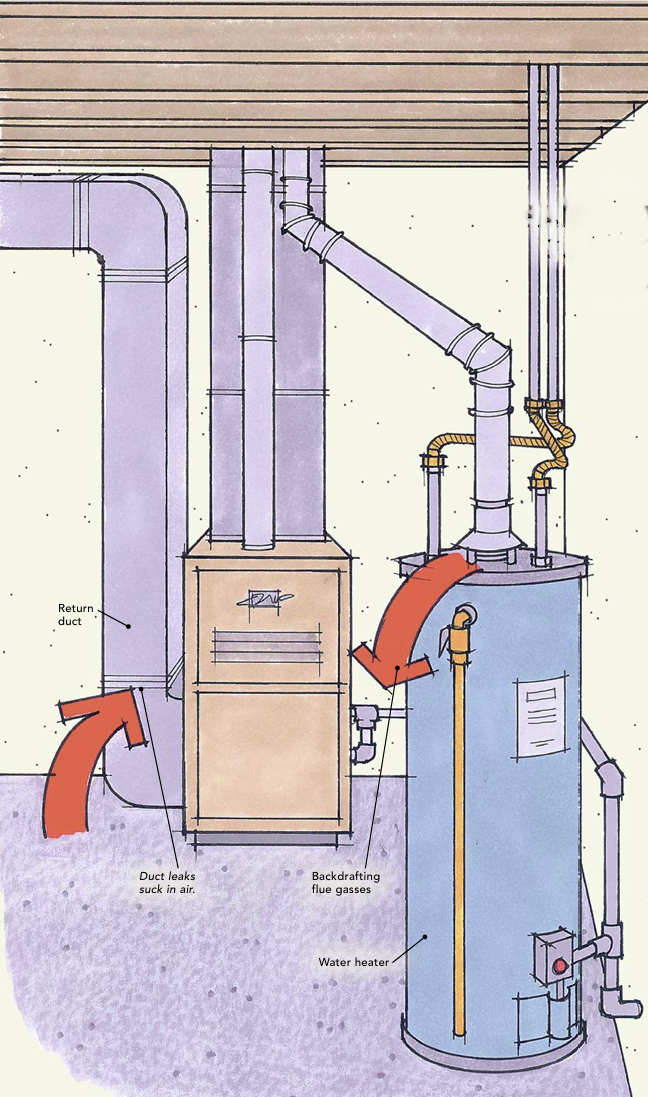
Leaky return ducts suck up bad stuff
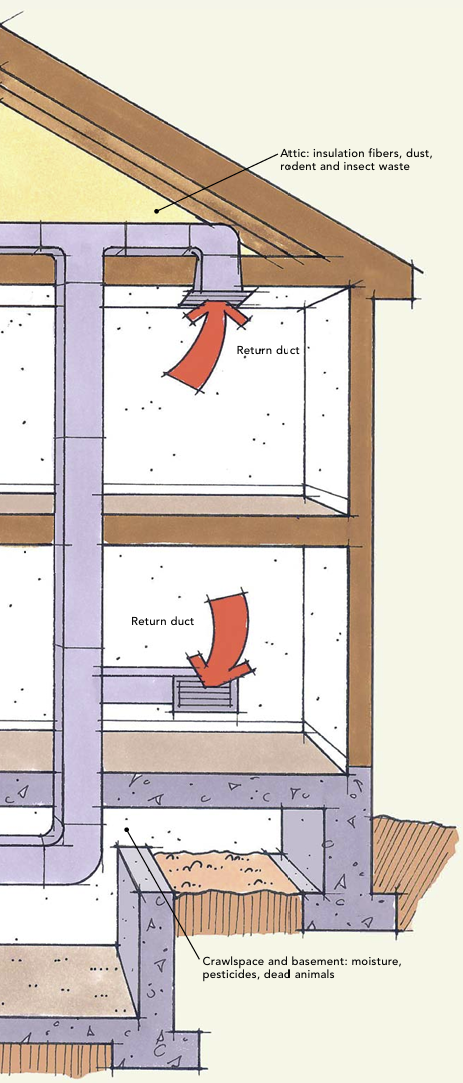
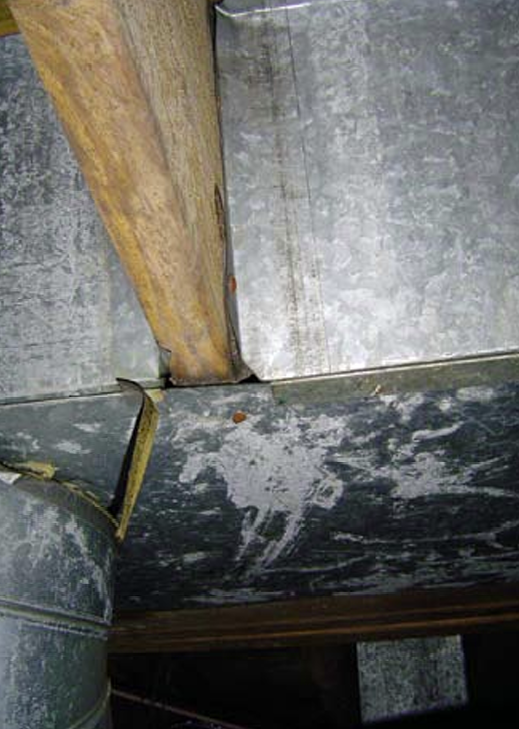
The most obvious way for a duct system to draw in bad air is through leaky return ducts, which often are placed in attics and crawlspaces. Leaks in ducts occur at unsealed joints and disconnected branches. Joints in ducts should be screwed together and sealed with mastic or with UL-181-listed butyl or oriented polypropylene (OPP) tape. Traditional cloth duct tape doesn’t last and shouldn’t be used. Panned returns, which are created by nailing pieces of sheet metal to the bottoms of adjacent floor joists, are another source of leaks. It’s practically impossible to seal the sheet metal to the joists, never mind all the cracks and holes typically found in joists and floors. Panned returns are common in older homes.
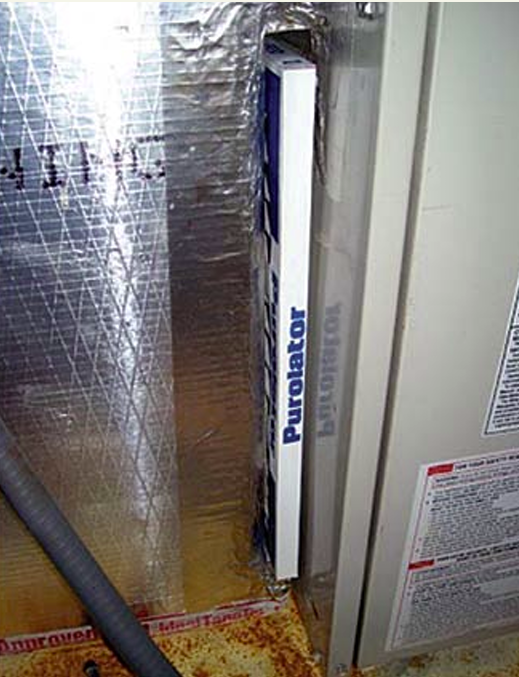
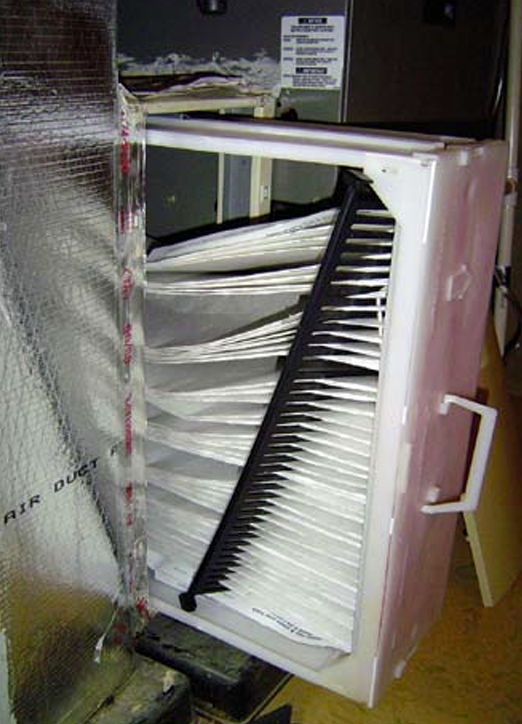
Bad air can be pulled in at the air handler or furnace as well. Air-handler cabinets are notoriously leaky and are usually installed in an attic, basement, or crawlspace. Filter housings and filters are often worse. Taping over the seams and penetrations in the air-handler cabinet is an excellent practice that can reduce leakage. Upgrading to a thicker, pleated filter instead of using the standard 1-in. filter also helps reduce leakage because the housing for those larger filters is tighter and has weatherstripping at the door.
High indoor humidity, which can lead to mold growth, is a common consequence of leaky ducts in a damp crawlspace or basement. In humid climates, vented crawlspaces are especially bad places to draw air from, as that air is replaced with limitless quantities of humid outside air. Oversize air conditioners in particular are often overwhelmed by extra humidity. For an air conditioner to dehumidify, it’s got to run long enough for the cold coil to condense moisture from the air passing over it. The longer an air conditioner runs, the more humidity it removes. Oversize air conditioners cool the air in the house quickly but shut down before they can dehumidify the air sufficiently. Despite that, oversizing is common. No HVAC contractor wants a callback for a system that doesn’t cool the house sufficiently. In my experience, the typical new home gets a heating and air-conditioning system that’s about two times too large.
Where ducts leak
Leaky supply ducts can make your house suck
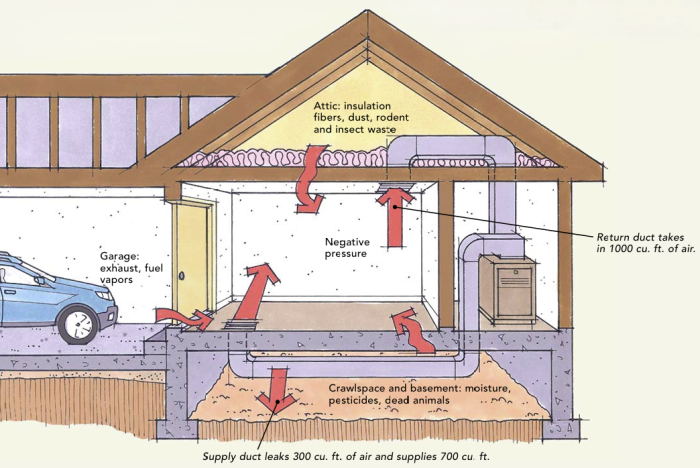
Not all the bad stuff happens in the return ducts; supply-side leaks can create IAQ problems as well. If a system’s return ducts pull 1,000 cu. ft. of air from the conditioned space, then the supply ducts should put 1,000 cu. ft. back in. However, it’s common for ducts to run outside the conditioned space in places such as attics or crawlspaces.
If the supply ducts outside the conditioned space leak, maybe only 700 cu. ft. of air make it all the way back to the conditioned space. But if you add 700 cu. ft. of air to a space and take away 1,000, you’ve got a negative amount. In this case, the conditioned space will be under negative pressure due to the unbalanced duct leakage. That negative pressure will suck those 300 missing cu. ft. of supply air from outside the conditioned space. The replacement air may be from the crawlspace. It may come from the attached garage. It may come from the attic. Somehow, some way, the house will get more air. And it may well be the kind of air you’d rather not breathe.
Commissioning an HVAC system
To be certain a new HVAC system (including the equipment and the ducts) works correctly, the contractor needs to test it, measure the results, and tweak the system appropriately. From what I’ve seen, this step is usually skipped. Some special tools and skills are required, so finding a con tractor to do the work might be a challenge. A good place to start is with a local HERS rater. Here’s a rundown of what commissioning entails.
There’s a lot of measuring to be done: the temperature drop across the air conditioner’s evaporator coil to be sure it’s within the manufacturer’s specs; the total static pressure to see if the ducts are too restrictive; the total duct leak age; the airflow from all of the supply vents and the airflow on the return side, which should equal. In addition to measuring, finding and fixing any big leaks is a key part of commissioning.
If there’s a mechanical ventilation system that draws in outside air, be sure there’s an electronic damper to prevent the air handler from pulling in outside air when it’s not supposed to. Measure the airflow to be sure the system is working as it’s designed to.
Commissioning identifies problems, corrects them, and then makes sure the fixes work. Some contractors may object to this step, but they won’t live in your house. You will. Protect your health by making sure your HVAC system is properly commissioned.
Allison A. Bailes III, PhD, is a speaker, writer, building science consultant, and the founder of Energy Vanguard in Decatur, Georgia. He has a doctorate in physics and is the author of a bestselling book on building science. He also writes the Energy Vanguard Blog. For more updates, you can follow Allison on LinkedIn and subscribe to Energy Vanguard’s weekly newsletter and YouTube channel.
Weekly Newsletter
Get building science and energy efficiency advice, plus special offers, in your inbox.