
Blog
Is a Humidifier in an Airtight House Ever Needed? – GreenBuildingAdvisor

In our HVAC design work at Energy Vanguard, we sometimes try to talk people out of things. I’ve discussed this in regards to makeup air systems for range hoods, but today let’s look at a different one: humidifiers. We don’t include this in our scope of work. If you think the indoor humidity is too low, you could put a humidifier in an airtight house, but you should be cautious in doing so. It might create more problems than it solves.
What’s the right indoor humidity?
I covered this question a while back but let me recap it here. There is no magic number for “the best” indoor relative humidity. Nor is there one for dew point, which is generally the best metric to use. As I wrote in the other article, it depends on several factors.
That’s why you’ll usually see a recommended range in which to keep the relative humidity. But even that range isn’t hard and fast. Excursions outside the range are OK as long as they don’t last too long.
A good range for indoor relative humidity in winter then would be 30 to 45 percent. But you’d better have a really good building enclosure with triple-pane windows if you want to attempt 45 percent in a cold climate.
What do experts say and do?
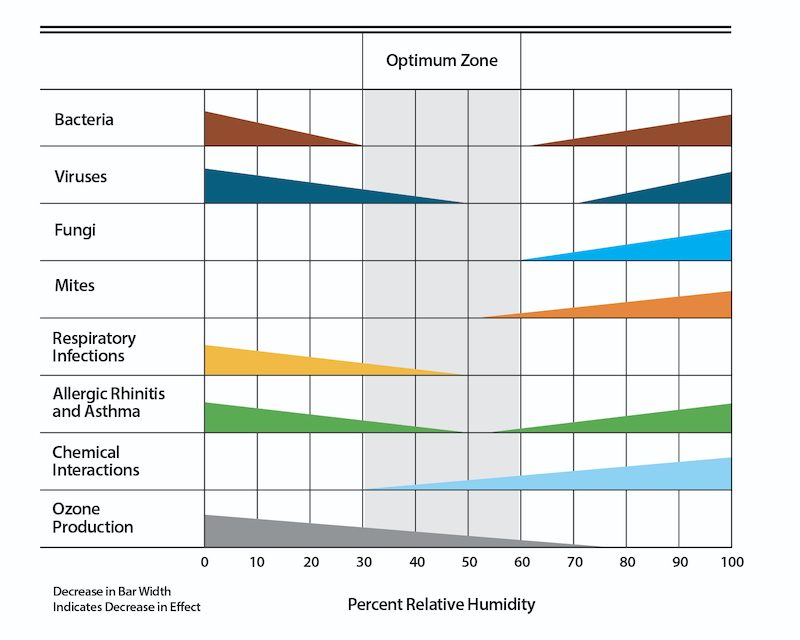
In the 1980s, a research paper claimed that the best range for indoor relative humidity is 30 to 60 percent. You may well have seen a version of the graph they included. It’s called the Sterling chart and the one I had made for my book is below. (For more background on this, see my article on that paper.)
Dr. Stephanie Taylor, a medical doctor with a degree in architecture, says that data from hospitals show that 40 percent should be the lower bound of the range, not 30 percent. I heard her say on a podcast that she uses a humidifier in her Vermont farmhouse to maintain a minimum of 40 percent relative humidity. That seems a bit scary to me, but she didn’t say what she’s done to improve the enclosure.
Gary Nelson, founder of The Energy Conservatory, lives in Minneapolis. You may recall that I wrote about how he heats his home with a heat pump that has no auxiliary heat. I called him this week, and he told me he never uses a humidifier in his home. Even so, his relative humidity stays between 30 and 35 percent in the coldest parts of winter. He’s got a great building enclosure with triple-pane windows and minimal air leakage, so he can stay at 30 percent or above without a humidifier.
Then I put the question to Lew Harriman, who made a career of investigating and writing about moisture problems. He said that he’d never say never to putting a humidifier in an airtight house. If you’ve got a building enclosure that can handle it and you don’t try to keep the indoor air too humid, it can work.
Why might the humidity be too low?
Occasionally, a client of ours will come back to us after the house is occupied and ask about adding a humidifier. We follow up with these questions:
- How airtight is the house?
- What ventilation rate are you using?
- Are you using an energy recovery ventilator (ERV) or a heat recovery ventilator (HRV)?
Airtightness is hugely important because every cubic meter of cold outdoor air that infiltrates the house dries out the indoor air. Cold air is dry air, you know. The more airtight the house, the less you have to worry about humidification.
The ventilation rate matters a lot, too. If it’s too high, it also can dry out the house. I spoke with a client in Seattle recently who was complaining of low humidity. He should have been running his ERVs at 180 cubic feet per minute (cfm) in total but instead had them maxed out at about 400 cfm. When he turned them down as I suggested, the indoor humidity was fine.
Then there’s the issue of the type of whole-house ventilation system. As I’ve written, most houses should have an ERV, not an HRV. An HRV will dry out the air as much as infiltration because it does no moisture recovery.
So, before you jump to the conclusion that you need a humidifier in an airtight house, check out those things.
3 types of humidifiers
When I spoke with Lew Harriman, the issue of humidifier type came up. He has a preference, which I’ll tell you below. First, here are the three types:
- Evaporative humidifier – Warm air blows over a wetted pad, evaporating water into the airstream. This type can get a bit nasty inside, especially if it doesn’t get cleaned regularly.
- Steam humidifier – Add heat and boil water to humidify the air. It takes more energy than the evaporative type.
- Ultrasonic humidifier – Ultrasonic vibrations create a fine mist to increase humidity. But if you don’t use pure water, whatever else is in the water ends up in the air, too, so you can get a boost in particulate matter as well.
Harriman says he would recommend the steam humidifier because it stays cleaner than the evaporative type and doesn’t add to the particulates the way an ultrasonic humidifier can.
A simple way to determine the right indoor humidity level
OK, let’s boil this down to an easy test you can do. If you’re thinking of putting a humidifier in an airtight house, you should start by measuring the indoor relative humidity. Thirty percent or higher is good. More than 45 percent is probably too high.
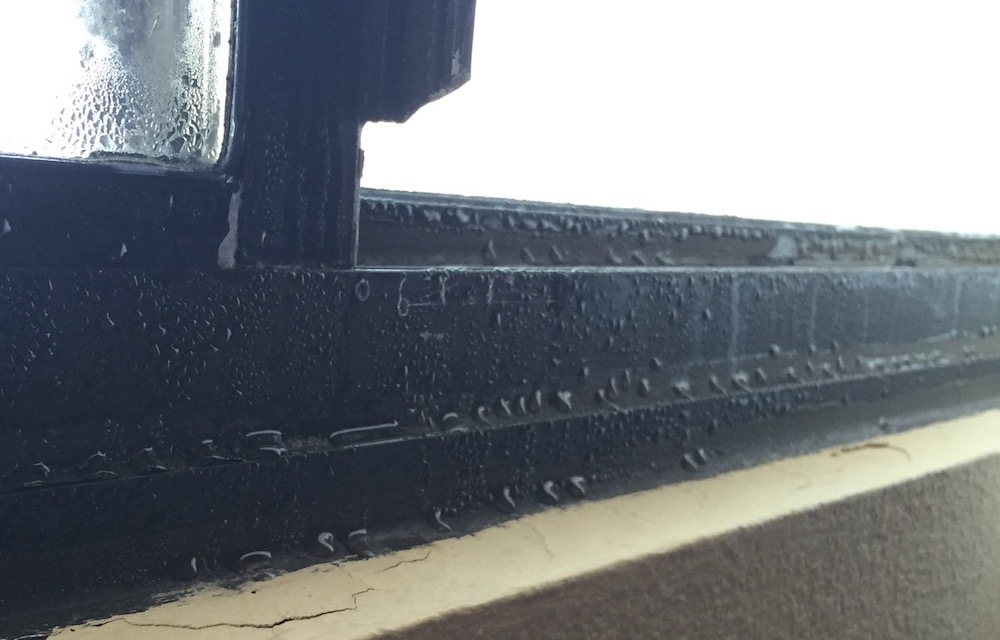
Now, here are those real-world tests:
- The humidity should be high enough that you don’t have a static electricity problem.
- The humidity should be low enough that you don’t have more than a bit of condensation on the windows, and it doesn’t start dripping down the way you see above.
And again, excursions outside those bounds can be OK if they don’t last long. If you have a constant problem with condensation on the windows, you may be in danger of rotting the building. Harvard found that out the hard way. (Yeah, I wrote about that, too.)
Lagniappe
Since this is winter and I’ve mentioned static electricity, you also ought to know that there is a National Static Electricity Day.
Allison A. Bailes III, PhD is a speaker, writer, building science consultant, and the founder of Energy Vanguard in Decatur, Georgia. He has a doctorate in physics and is the author of a bestselling book on building science. He also writes the Energy Vanguard Blog. For more updates, you can follow Allison on LinkedIn and subscribe to Energy Vanguard’s weekly newsletter and YouTube channel.
Weekly Newsletter
Get building science and energy efficiency advice, plus special offers, in your inbox.