
Blog
Do You Need a Bigger Air Conditioner if You Install a Dehumidifier? – GreenBuildingAdvisor
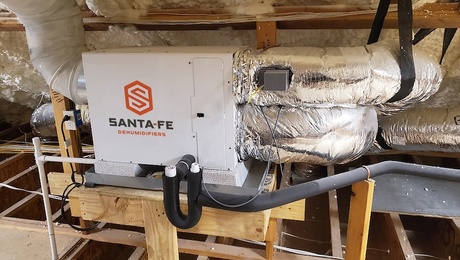
Those of us in humid climates know the importance of having good dehumidification along with good cooling for comfort. Dehumidifiers, however, blow hot air into the living space. So what happens when you add a dehumidifier? A lot of people think you also need to add more air-conditioning capacity. Is it true? Let’s look at the critical factors that will reveal the answer for us.
Dehumidifier number 1: Your air conditioner
First, the air conditioner should be doing the bulk of your dehumidification. But that depends on runtime, and runtime is determined by the capacity of the AC. And where does the capacity (size) come from? Well, it should be based on the 1 percent design conditions for your location.
If you actually have a system that’s sized according to the HVAC design protocols from the Air Conditioning Contractors of America (ACCA), you shouldn’t have much need for a dehumidifier when you’re at the design conditions for your location. That’s even true for inverter-driven equipment (i.e., minisplits). As I wrote recently, my ducted minisplit heat pump keeps my house in the 45 to 55 percent range of relative humidity when we’re having design condition weather.
To get that kind of performance from your air conditioner, though, it really needs to be sized as close to the actual load as possible. Mine is sized at about 90 percent of the total load, which meets the Manual S requirement. That helps a lot with dehumidification. But again, we’re talking about design load conditions here, which by definition we’re at only about 1 percent of the time. The remainder of the time, we’re mostly at part-load conditions.
Two kinds of heat
And speaking of cooling loads, remember (or know for the first time) that we calculate two components of the total load: the sensible load (think temperature reduction) and the latent load (think dehumidification).
When the dehumidifier runs, yes, it blows hot air into the living space. But is that an additional load? No, not much anyway. It’s mostly cooling load that has already been accounted for in the load calculation.
Another way of thinking about a dehumidifier is that it’s a device that converts latent load into sensible load. It’s the same heat, just transformed from being hidden (latent) in humidity to in-your-face higher-temperature air. But yeah, there’s a little extra heat thrown in because the dehumidifier isn’t 100 percent efficient.
So, no, you don’t need to increase the size of the air conditioner just because you’ve added a dehumidifier. Now let’s look at the issue of timing.
When does the dehumidifier run?
When your house is at design conditions, the AC should be running pretty much continuously at or close to maximum capacity if it’s sized properly. That should keep the indoor relative humidity where you want it without the dehumidifier coming on.
But design conditions don’t last 24/7. It’s there in the afternoon and maybe into the evening. But at night, the outdoor air cools down. And that’s when you might need that dehumidifier.
In technical terms, you have a lower sensible load at night. As a result, the air conditioner runs less. That may cause the indoor humidity to rise. And that’s when the dehumidifier swings into action.
So your dehumidifier is mostly blowing hot air into the house at a time when the AC isn’t operating at full capacity. If the dehumidified air starts making the house too warm, the AC can run more.
Dehumidifier takeaways
Here’s the skinny:
- Dehumidifiers convert latent cooling load to sensible cooling load.
- Dehumidifiers add only a little extra cooling load.
- Dehumidifiers mostly run at night or on cooler days, when the air conditioner has extra cooling capacity.
- Air conditioners should be able to handle all or most of the dehumidification on hot days.
None of this means you won’t have comfort problems with a dehumidifier in the house. Everything I’ve said above depends on proper HVAC design. If your AC is twice the size it should be, you may well have some comfort problems in your house. And if you do increase the size of the AC because of the dehumidifier, you may well end up there.
Also, how you deal with the output of the dehumidifier—the hot dry air—can affect your comfort. If it blows directly into the living space, it needs to be well-mixed with room air before hitting the occupied zone. And if the dehumidifier output goes into the air conditioner ducts, you have to understand the intricacies of that process.
So, no, you usually do NOT need a bigger air conditioner just because you’ve also installed a dehumidifier. If this is something you need help with, contact us through our HVAC design pages.
Allison A. Bailes III, PhD is a speaker, writer, building science consultant, and the founder of Energy Vanguard in Decatur, Georgia. He has a doctorate in physics and is the author of a bestselling book on building science. He also writes the Energy Vanguard Blog. For more updates, you can follow Allison on LinkedIn and subscribe to Energy Vanguard’s weekly newsletter and YouTube channel.
Weekly Newsletter
Get building science and energy efficiency advice, plus special offers, in your inbox.