
Blog
Do Mini-Splits Really Have a Dehumidification Problem? – GreenBuildingAdvisor
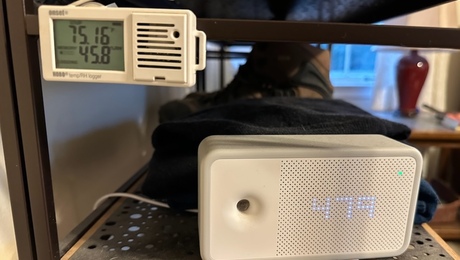
It’s time for another update of my ongoing personal heat-pump case study. I wrote here in 2020 about how the inverter-driven mini-split heat pump serving most of my main floor is undersized for cooling and for heating. And I followed up with how well it performed in a heat wave in 2022 and in an arctic blast in 2023. Now it’s time to show you how it’s been doing with humidity control on hot summer days. Many people say that mini-split heat pumps have a dehumidification problem in cooling mode. But is it true?
The video above covers a lot of what’s here in the article and provides more context.
3 days of data
I’ve got three graphs of temperature and humidity data below. They’re from the HOBO data logger in my bedroom. In the next section I’ll discuss what the outdoor conditions were like during this period, but first, here’s the graph of the dry bulb temperature (also known as just temperature) in my bedroom.
As you can see, the temperature goes up and down throughout the period. It went as low as 73°F and as high as 78°F. Those two extremes, however, were outliers in the 72 hours covered here. Mostly the temperature was between 75°F and 77°F. The average of all the temperature data is 75.6°F. The red horizontal line at 75°F is the indoor design temperature I used in the load calculation.

Next, you see below the graph of the relative humidity in my bedroom. Again, the red line is the design condition, or 50 percent relative humidity in this case. Unlike with the temperature, though, this parameter spends almost as much time below the red line as above. So over this three-day period, we averaged 50.6% relative humidity. Only once did it go above 60% relative humidity.

And now let’s look at my favorite psychrometric variable for humidity, the dew point temperature. The design conditions of 75°F and 50% relative humidity correspond to a dew point of 55°F. That’s the red line. Our average dew point during those three days was 55.9°F. Who says mini-splits have a dehumidification problem?

Based on the data from these three days, I think it’s safe to conclude that my inverter-driven mini-split heat pump does NOT have a dehumidification problem. But there’s more to it than what I’ve shown you so far.
The corresponding outdoor conditions
Of course, one of the first questions you should ask is what the outdoor conditions were. That has a significant bearing how the heat pump and the house will perform. First, it didn’t rain any of those days and had been dry for a few days before as well. The screenshot below shows that it was mostly sunny. And we had typical summer weather for Atlanta. In fact, those three days were pretty close to being design days, with high temperatures of 91°F, which is just below our summer design temperature of ~92°F. The low temperatures were 70°F each day.

But what about the outdoor humidity? According to Weather Underground, our dew point temperatures ranged a low of 63°F to a high of 69°F over that period.
- July 4: 64°F–69°F
- July 5: 64°F–69°F
- July 6: 63°F–67°F
That’s definitely on the humid side, but it’s not nearly as bad as it gets in Florida or in other hot, humid climates. Orlando, for example, had dew points between 70°F and 78°F during the same period.
The outdoor temperature matters because the hotter it is, the more the heat pump runs. And the more it runs at higher capacity, the more it dehumidifies. The outdoor humidity matters because our house is not an ultra-high vacuum chamber. Some of that humid air does find its way indoors.
And that brings me to the last part.
Other factors that help
As you can see from the above, the indoor conditions were close to what I designed for. The outdoor conditions were also close to the design conditions, and that helped. But there were a few other factors that played a role here too.
Aggressive sizing. I mentioned above that my heat pump is undersized for cooling. Actually, it does meet the ACCA Manual S requirement for equipment sizing—or almost, anyway. Manual S allows you to size an air conditioner or heat pump in cooling mode as low as 90% of the Manual J cooling load. The one I’ve been discussing here is slightly below that, at 88%. And that helps because it keeps the compressor cranking at above the minimum capacity for more hours of the day. A lot of people think you can’t oversize a mini-split because of its variable capacity, but they’re wrong. When you size to the lower end of the range, you get better dehumidification.
Airtightness. My house was built in 1961. Before 2012, it had a lot of air leakage. Since that time, our blower-door-measured airtightness has gone from about 17 air changes per hour at 50 pascals (ACH50) to 7 ACH50. That means we’re not fighting the outdoor humidity nearly as much.
Energy recovery ventilator. A final reason that our indoor humidity is under control is that we have a Zehnder Q600 energy recovery ventilator (ERV) for whole-house mechanical ventilation. It brings outdoor air into the house, but it reduces the amount of humidity that comes in with that outdoor air. Yes, it does still add humidity to the house, but it doesn’t add nearly as much as it would if we were bringing outdoor air straight into the house with moisture recovery.
What about ductless mini-splits?
My focus in this article has been on the performance of one of the three heat pumps in my house. That heat pump has two indoor units, both ducted. And it performs pretty much perfectly during regular summer weather. But what about ductless mini-splits? Do they have a dehumidification problem?

The photo above shows the relative humidity (91%) and dry bulb temperature (41.5°F) of the supply air coming out of the unit. That’s an astounding 39°F dew point! The temperature in the room was about 72°F. So yeah, that thing makes a super-cold coil and was giving me a 30°F temperature drop at the time I took the photo.
Is it condensing water on that cold coil and dehumidifying the room? You bet! I know that for a fact because we had a little leakage problem in the condensate line that dumped a bunch of water onto the counter below. We got that fixed without too much difficulty, so now all that condensate is going where it’s supposed to go. So we don’t seem to have a dehumidification problem with our ductless units either.
No sweat!
The answer to the title question is yes. Well, at least that’s the case for my Mitsubishi heat pump on hot summer days. As they say about cars, though, your mileage may vary. The aggressive sizing, airtightness, and energy recovery ventilator all help. So does the moderate outdoor humidity.
The real takeaway here is that mini-splits can do well at controlling humidity in hot weather. Do things right and you shouldn’t need a dehumidifier for those conditions. That doesn’t mean you don’t need a dehumidifier, though. There are plenty of cooler, humid days when no air conditioner or heat pump will control humidity, especially in the fall, spring, and even winter. For those days, you’ll probably want a dehumidifier.
Allison A. Bailes III, PhD, is a speaker, writer, building science consultant, and the founder of Energy Vanguard in Decatur, Georgia. He has a doctorate in physics and is the author of a bestselling book on building science. He also writes the Energy Vanguard Blog. For more updates, you can follow Allison on LinkedIn and subscribe to Energy Vanguard’s weekly newsletter and YouTube channel.
Weekly Newsletter
Get building science and energy efficiency advice, plus special offers, in your inbox.