
Blog
Blower Doors and Body Mass Index – GreenBuildingAdvisor
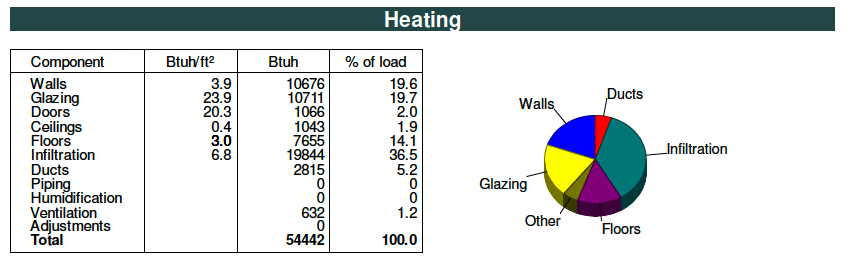
Let’s talk about the blower door today. It’s one of the most important tools for analyzing the performance of a house. And it’s THE tool for quantifying air leakage. That, of course, is related to energy use, comfort, indoor air quality, noise, and durability of a home. The screenshot below shows that air leakage (infiltration) is the largest part of the heating load in this older house in Atlanta.
But putting the results in proper context can be tricky. So here I’ll start with an explanation of what a blower door does and what it measures. Then I’ll show you how blower doors are related to body mass index. Really!
The physics behind blower doors
A house is not a vacuum chamber. It has holes that leak air. That’s true for even those homes with extreme airtightness, like the ones that meet Passive House requirements.
There’s a lot of interesting physics around air leakage. Here are the essentials you need to know to understand blower door testing:
- Air moves from one place to another (e.g., indoors to outdoors) only when there’s both a pathway and a pressure difference.
- When a unit of air leaves the building, an equal unit comes in somewhere else to replace it. So when a cubic foot (or cubic meter) of air leaks out, another cubic foot (or cubic meter) leaks in. (It’s not strictly true all the time because there are brief moments of non-equilibrium flow.)
And that’s really all you need to know to understand what blower doors do.
What a blower door does
A house has holes in the building enclosure. Those holes are the pathways.
The pressure differences that drive air through the holes arise from one of three sources: wind, stack effect, and mechanical systems (e.g., exhaust fans, duct leakage). For now, all you need to know is that houses will always have pathways and that pressure differences are almost always present too.

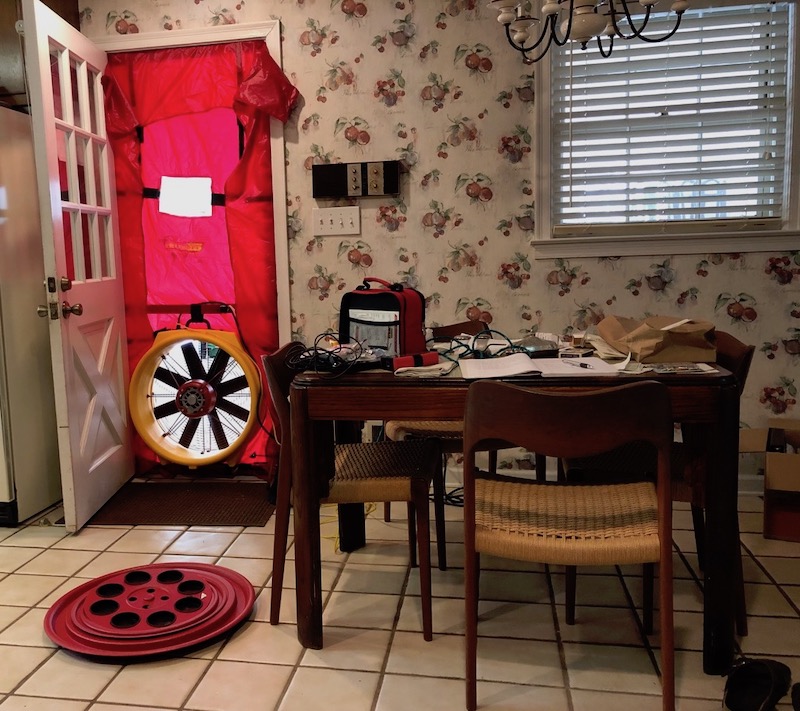
What we want to do with a blower door is get a feel for how much air leaks through those holes. So we put a fan in a doorway. The fan creates a pressure difference between indoors and outdoors. That pressure difference is larger than typical pressure differences because we want most of the air to be moving because of the blower door.
The last step is measuring how much air is moving through the fan. We can do that because companies like The Energy Conservatory and Retrotec have spent the past several decades perfecting this important tool. A blower door has a calibrated fan, and that’s how we can tell how much air moves through it.
Blower door results
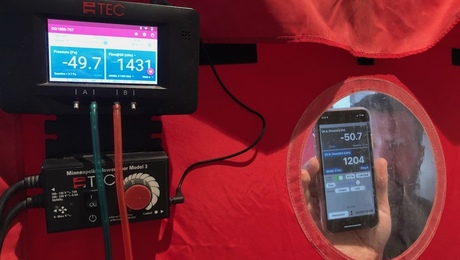
Let’s dig into what I just said, though, and see what it really means. Yes, a blower door tells you how much air moves through the fan when it’s running. But that’s not what it’s measuring directly. With the house at a given pressure difference (usually 50 pascals for a single point test), the pressure gauge (manometer) measures the pressure of the air going through the fan.
So here are the first- and second-level results you get from a blower door:
- Pressure of the air moving through the blower
- Airflow rate in cubic feet per minute, cubic meters per hour, or liters per second
The airflow rate is more useful than the pressure of the airstream. But it’s not a great way to compare one house to another or to a threshold you need to meet for the building code or program requirements. And that brings us close to the issue of body mass index.
A weighty matter
Here’s how I described the problem in my book:
The only problem with using the air flow rate at 50 Pascals is that it doesn’t factor in the size of the house. If I told you, for example, that I have a friend who weighs 150 pounds (68 kg), you don’t know anything about whether he’s morbidly obese, anorexically skinny, or somewhere in between. If I tell you he’s 7 feet tall (2.1 m), you know he’s skinny. The body mass index is a single number that accounts for both weight and height, and we need something similar for air leakage.
The primary way to convert an infiltration airflow rate to something we can use to compare one house to another is air changes per hour (ACH). Basically, it’s just changing the units. If we start with cubic feet per minute, we change cubic feet to air changes and minutes to hours. The first conversion assumes that one air change equals the volume inside the house. The second is 60 minutes equal one hour.
Pretty easy, eh? Now at least we have something that allows us to compare one house to another.
Stepping it up
The next step is specifying the pressure at which those air changes per hour happen. With the blower door keeping the house at a pressure difference of 50 pascals (Pa), we have the—wait for it—air changes per hour at 50 Pa, or ACH50. This is what most building codes and programs specify. Georgia, for example, requires all new homes to be tested and achieve an airtightness of less than 5 ACH50.
Then there’s trying to find out what the air leakage rate would be at more normal house pressures. You’ll sometimes see mention of “natural air changes per hour,” or ACHnat. It’s a rough estimate, but we need to be able to do that for heating and cooling load calculations and energy modeling.
But there’s an even better way to characterize the results you get from a blower door test. Yes, air changes per hour does let you compare one house to another, but there’s a flaw. It’s based on volume, but leakage happens at the surface. That leads to an unfair advantage for larger houses. (See my articles on this topic for more detail.)
The answer to that problem is to use surface area of the air barrier instead of volume inside the house. The result there would be given in terms of the blower door air leakage rate (cubic feet per minute or cubic meters per hour) and surface area (square feet or square meters). For example, Phius requires most projects to come in at 0.06 cfm50 per square foot of enclosure (air barrier).
And there you have it. The airflow rate from a blower door test (e.g., cfm50) is like weight. When you factor in the volume or surface area, now you’re doing something like body mass index. But of course, I’ve mentioned a few ways to do the body mass index conversion with blower door results, and there are even more. So you probably won’t be surprised that there are alternatives to body mass index too.
Allison A. Bailes III, PhD is a speaker, writer, building science consultant, and the founder of Energy Vanguard in Decatur, Georgia. He has a doctorate in physics and is the author of a bestselling book on building science. He also writes the Energy Vanguard Blog. For more updates, you can follow Allison on LinkedIn and subscribe to Energy Vanguard’s weekly newsletter and YouTube channel.
Weekly Newsletter
Get building science and energy efficiency advice, plus special offers, in your inbox.