
Blog
2 Common Comfort Problems Caused by Air-Conditioning – GreenBuildingAdvisor
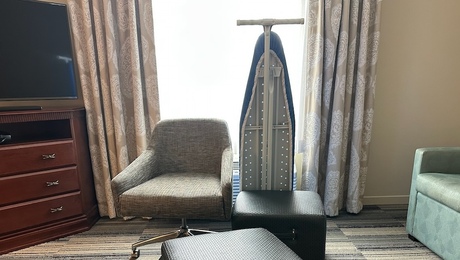
No, that’s not an art installation or a privacy screen. What you’re looking at in the photo above is a hotel room I stayed in recently. Behind the chair and the ironing board is the air-conditioning system. The bed was right behind me as I took the picture. Do you know which of the many common comfort problems I was trying to fix?
Problem 1: Airflow
I placed the chair and ironing board right there to deflect the airflow. In the bed, I felt a strong, cold breeze that shot right across the room. It was quite uncomfortable. With the deflectors in place, I didn’t feel much of the airflow and was much happier. I played with the fan speed to see if lowering it would help, but it didn’t. Only the deflectors helped.
This experience, which I’m sure is common in many homes as well, is the result of HVAC designers and installers not following one of the cardinal rules of HVAC design: Don’t blow air on people. If you click that link, you’ll see that that is the first of 17 things I listed to improve duct systems.
Yes, cool air blowing on you can feel nice if you’re exercising, sitting in a warm room, or having a hot flash. Generally, though, it’s not a recipe for comfort.
If you have heating and cooling vents in your home with this problem, you may be able to adjust the louvers to deflect the air. If that doesn’t work, you could try changing to a different kind of register. For example, if you have the type shown below, you can change the direction of airflow by adjusting the horizontal louvers in back and the vertical louvers in front. (This one is the Hart & Cooley 618.)

If that doesn’t do it for you, try something like the two-way supply register shown below (Hart & Cooley 682).

Now, what about the other of the two common comfort problems?
Problem 2: System size
The second problem in my hotel room was the capacity of the air conditioner. As is true for most hotel rooms, the cooling load was low, and the AC was oversized. That meant that it would come on for a few minutes and then go off. So I was repeatedly throwing the covers off and then covering up again throughout the night.
That problem isn’t quite as easy to fix after the fact—unless you’re ready to replace the air-conditioning system. If that’s the case, go read my article about how to find out what size AC you need without doing a heating and cooling load calculation. If that doesn’t work—or if you’re building new and want to avoid this problem from the start—you can get a full load calculation and equipment selection. (We do that and so do other companies.)

But it’s not just a smaller system that could help. Choosing one that operates in two or more stages or with variable capacity is a great option. It can still have the maximum capacity you’ll need for the hot days but can ramp down to cover the many, many more hours of lower temperatures (also known as part-load conditions). That helps it run longer, evening out the indoor temperature. Pretty much all of the HVAC systems we design at Energy Vanguard are of the multistage or variable-capacity types.
Do you have either of these two common comfort problems in your home?
Allison A. Bailes III, PhD, is a speaker, writer, building science consultant, and the founder of Energy Vanguard in Decatur, Georgia. He has a doctorate in physics and is the author of a bestselling book on building science. He also writes the Energy Vanguard Blog. For more updates, you can follow Allison on LinkedIn and subscribe to Energy Vanguard’s weekly newsletter and YouTube channel.
Weekly Newsletter
Get building science and energy efficiency advice, plus special offers, in your inbox.