
Blog
Radiant Cooling in Humid Climates: Does It Work? – GreenBuildingAdvisor
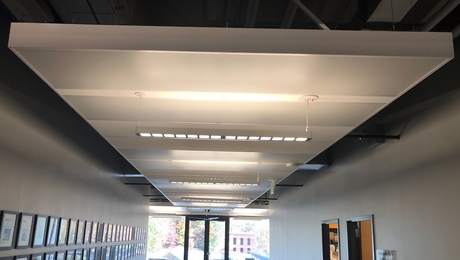
Imagine a sunny spring day. You’re feeling warm from the sun as you walk down the street. Then you go into a big concrete parking deck. Suddenly you feel a chill. That’s radiant cooling. (And it was radiant heating from the sun before that.) The massive concrete is still cool from winter. You walk through and your body radiates heat into the cooler concrete. We can use that physics to do radiant cooling in homes too. But is radiant cooling in a humid climate practical? Humid air and cool surfaces can do things we don’t want.
It’s certainly being done, and the photo above proves it. Those are radiant heating and cooling panels hanging over a hallway in ASHRAE’s new headquarters here in the Atlanta area. I took the photo when I went to the ribbon cutting ceremony in 2021. So let’s take a look at the issues and find out if there really is anything to be afraid of.
The benefits of radiant heating and cooling
Radiant heating and cooling can be one of the best ways to make people comfortable at home. The basic science of the comfort is in an article I wrote a long time ago called Naked People Need Building Science. And yes, it applies to clothed people as well.
The science I wrote about there was mean radiant temperature, which is the average temperature of all the surfaces in the room. Those temperatures are important, because our bodies exchange more heat with our surroundings through radiation than through conduction or convection. It’s far more important than the temperature of the air. In fact, about 60 percent of the heat exchange between our bodies and the surrounding environment occurs through radiation.
Another benefit of radiant cooling is that there’s no ductwork for forced-air cooling. Hydronic tubes take up less space than air ducts. I believe they also have fewer performance problems. Check out some of the many horrific design and installation problems with air ducts I’ve written about in this blog (e.g., here, here, and here).
Then there’s the potential IAQ benefit. Air-conditioning coils and drain plans can provide a nice habitat for a wide variety of microbes. You know—biofilms, slime, and gunk. And when they do, pollutants can get into your lungs, because the air being cooled blows right over that stuff. I said it’s a potential benefit, though, because high-efficiency filtration and airtight ducts will keep the coil and pan clean for the lifetime of the AC.
Avoiding condensation
Now let’s get to the potential for trouble with radiant cooling in a humid climate. The knee-jerk reaction when someone mentions radiant cooling in a humid climate is “You’ll get condensation.” I’ve certainly been guilty of doing that myself. Let’s discuss this.
First, radiant cooling works great in a hot, dry climate. You can chill the water without having to worry about dropping the temperature of the chilled surfaces below the dew-point temperature of the air.
But in a humid climate, the dew-point temperature of the indoor air is of paramount importance, especially with radiant cooling. Here in Atlanta, for example, percent relative humidity excursions into the mid-60s do occur, even with air-conditioning. Ideally, they don’t last very long, but the weather this summer has been tough for humidity control.
If you’re using radiant cooling, whether in a concrete floor slab or lightweight panels on the walls or ceilings, you’ve got to have tight control over the humidity. If the indoor temperature is 75°F and the relative humidity is 65%, the dew point is 62 °F.
To avoid the potential for condensation, then, radiant-cooling professionals usually recommend that the radiant-cooling surfaces operate at 65°F or higher in a humid climate. So you get a temperature difference (ΔT) of about 10°F. Is that enough to get sufficient cooling capacity? Keep reading.
You still have to deal with the humidity
Let’s contrast this with dry-climate radiant cooling again. There you install your radiant-cooling system, and you’re done. You don’t have to worry about condensation or keeping the indoor humidity low. The dry climate does that for you. But with radiant cooling in a humid climate, you’re not done.
If all you do is install a radiant-cooling system instead of air-conditioning, you’re in for trouble. When I mentioned percent relative humidity in the mid-60s above, I was talking about what happens in a lot of air-conditioned homes.
Without air-conditioning or other types of dehumidification, a house in a humid climate will quickly turn into a mold farm. And if you’re cooling the house with radiant slabs, you’ll be slipping and sliding on the sweating floors too.
That means you must install a dehumidifier. This isn’t optional for radiant cooling in a humid climate.
Radiant-cooling capacity
In my last article, I covered the physics of radiant cooling. (OK, heating, too, but that’s not part of the discussion here.) I started with the Stefan-Boltzmann equation and its temperature to the fourth power and went all the way through to how much cooling capacity you can get for typical conditions. If you like math, you really ought to read through the derivation. I had a lot of fun putting it together.
In the end, I wrote that you can get 15,000 to 25,000 BTU per hour of cooling capacity for each thousand square feet of panel area. I worked through an example where the result was ~24,000 BTU/hr per thousand square feet.
Is that enough? In new homes, absolutely. Easy peasy. With radiant panels and a dehumidifier, you’ve separated the two types of cooling: sensible (lowering temperature) and latent (lowering humidity). The radiant-cooling panels handle only the sensible load.
If you build a house to the current energy code—heck, even if you use the 2006 energy code—being able to cool a house with 1.5 to 2 tons of sensible cooling for each 1,000 square feet isn’t hard. That’s old-school rule-of-thumb levels of cooling capacity.
Radiant-cooling cost
What about the cost of radiant-cooling panels? I don’t have much hard data on this, but one manufacturer (Messana) of this equipment put some numbers on its website: “Typical cost for just the Messana components is around $15-20 per square foot and $40-45 per square foot installed.” The square footage they’re talking about is the conditioned floor area of the house. Therma-HEXX systems are also in that ballpark and include the heat pumps and everything you need.
But there are other systems out there with lower costs. I’ve seen some claiming you can do it for as low as $10 per square foot, although I’m not sure that includes everything (e.g., the cooling equipment).
Let’s say you’re building a 2,500-square-foot house. At $40 per square foot, your total installed cost is $100,000. Whoa! And then there’s still the dehumidification. Fortunately, that cost will be a tiny fraction of the radiant-cooling cost.
If you can get it installed in that same house for $10 per square foot, you’re now down to $25,000 for a 2,500-square-foot house. That’s still significantly higher than you’d pay for a lot of heat pumps or air conditioners for that size house. But it’s comparable to high-performance equipment like the inverter-driven heat pumps in most of our HVAC designs.
Yes, radiant cooling in a humid climate can make sense
Radiant cooling in a humid climate has some nice advantages over air-conditioning. It doesn’t eliminate moving air in a home, though. You still have to dehumidify. You also need to move ventilation air and get some filtration happening to catch the particulate matter.
The condensation issue is the one that gets mentioned first, but it’s exaggerated. And hey, it’s not like homes with air-conditioning don’t have condensation problems. You’ve probably seen water droplets on a cold air-conditioning supply vent, right?
We have the knowledge and the technology to design and install radiant-cooling systems that will stay dry and provide enough (sensible) cooling capacity. The main problems with these systems are cost and finding someone who knows hydronics in hot or warm humid climates like the southeastern United States.
Allison A. Bailes III, PhD, is a speaker, writer, building science consultant, and the founder of Energy Vanguard in Decatur, Georgia. He has a doctorate in physics and is the author of a bestselling book on building science. He also writes the Energy Vanguard Blog. For more updates, you can follow Allison on LinkedIn and subscribe to Energy Vanguard’s weekly newsletter and YouTube channel.
Weekly Newsletter
Get building science and energy efficiency advice, plus special offers, in your inbox.