Blog
Advice for reducing sound from HRV return ducts – GreenBuildingAdvisor


We are rebuilding a 572 sq. ft 1948 cottage in Eugene, OR. We’ve done a good job making the cottage airtight, and for air quality have installed a Broan AI Series B150H75NT.
When we commissioned it, we’re getting excessive sound from the two vents of the return ducting. That ducting is very simple: All 5″ rigid. The two legs from the vents come to a 6″-5″-5″ wye, then a 6″->5″ reducer to the unit’s 5″ port. The unit is intended to run 24×7 at it’s lowest speed of 35 cfm.
Frequency tests and a few experiments suggest the noise arises from the mechanical noise in the unit, rather than turbulence or vibration in the ducting.
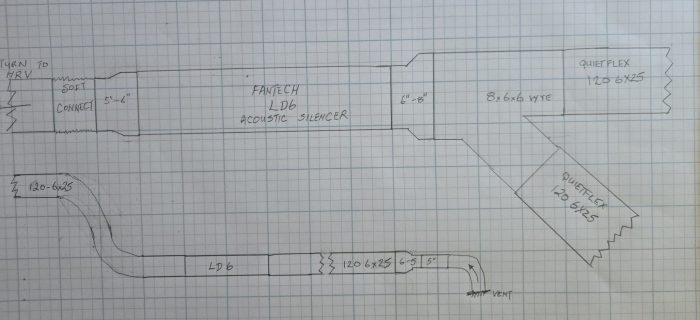
My tentative plan is to replace the rigid metal with the following sections from the HRV port to the bathroom ceiling. (Keep in mind that the airflow is from the vent to the HRV port.) I’ve attached a drawing. Note that I’ve since made a few mods to the path and added the IR6 damper.
This section is “locked in” from the initial install:
HRV 5″ vertical port => rigid metal 1D 90° turn, 2′ of 5″ metal duct across the top of the HRV
NEW ducting:
=> Short, flexible 5″ canvas connector => 5″-6″ increaser => 6″ Fantech LD6 Acoustic Silencer => 6″-8″ increaser => 8″x6″x6″ wye => Two legs “A” and “B”.
Leg “A”: 6″ Quietflex 120 6″ flexible duct … 1.5D 90° turn (down) … 1.5D 90° turn (across rafter ties) => Fantech IR6 “iris” damper => Fantech LD6 Acoustic Silencer => 6″-5″ reducer => rigid metal 1.5 D 90° turn (down) => 5″ vent & grill.
Leg “B” would have a similar sequence, but slightly different geometry.
I’d appreciate any advice on elements and layout.
And yes, if I’d only known, I would have initially run a complete 6″ acoustic flex with silencers and at least 1.5D turns.
GBA Detail Library
A collection of one thousand construction details organized by climate and house part
Search and download construction details