
Blog
Building Ω: Mechanical Systems – GreenBuildingAdvisor

Small heat pumps, balanced ventilation, solar power, battery storage, and exceptional airtightness helped turn an ambitious owner-builder project into a net-zero reality
By Amber Westerman , Clay Yapp |
Over the past few years, as a designer and construction coach, I’ve had the privilege of helping homeowners navigate the complex path to net-zero. In an introductory article, we met Clay and Danielle in rural Wauzeka, Wisconsin (climate zone 5A), and discussed the design of their two-story, 1536-sq.-ft. home. In a second article, we followed them from framing through insulation. In this final article, we’ll cover the mechanical systems that made net-zero possible, and the blower-door test that proved their air-control strategies worked to create a practical, affordable, resilient, and healthy home.
Right-sizing the heat pump
Because high-performance, airtight homes have very low heating and cooling demands, off-the-shelf mechanical systems are often oversized. Having never engineered a mechanical system before, Clay completed a room-by-room Manual J calculation to determine the exact heating and cooling demands of the home. Based on the data and by referencing NEEP’s Cold Climate Air Source Heat Pump List, he selected a 9,000-Btu/hour ductless air-source heat pump (ASHP) for the main floor and a 6,000 Btu/hour unit for the second story. These small minisplits were intentionally slightly undersized, to minimize energy-wasting short-cycling while maximizing interior dehumidification during the summer.
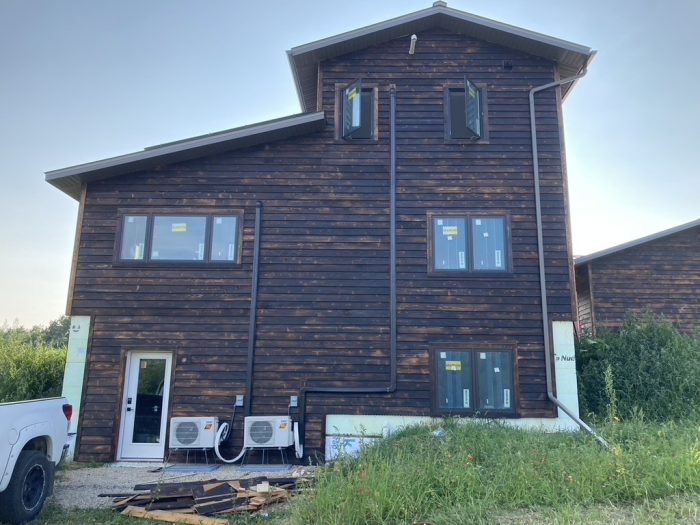
Considering our climate, where the shoulder seasons make up most of the year (not to mention some mild winters that I’m sure aren’t ominous), I’d rather have something smaller that needs a little help a couple nights of the year than a big hoss who inflates my electric bill the rest of the time. —Clay Yapp
Designing the ventilation system
To ensure a constant flow of fresh air (whenever windows are closed), the couple installed a fully ducted energy-recovery ventilator (ERV). The system extracts stale, humid air from the bathrooms and kitchen, runs it through a high-efficiency core to…
Weekly Newsletter
Get building science and energy efficiency advice, plus special offers, in your inbox.

Sign up for a free trial and get instant access to this article as well as GBA’s complete library of premium articles and construction details.
Already a member? Log in