
Blog
How Standardization Could Make 3D Printed Homes More Scalable
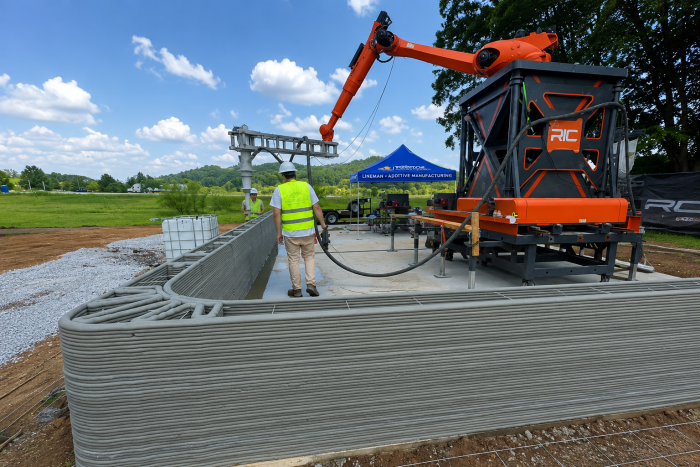
Colorado-based RIC Robotics’ solution to scalability is simple: standardize everything
 By Justin R. Wolf |
The industrial era of the early 20th century was defined by friction. Despite its many success stories, from the first radio receiver to the automobile, from stainless steel to the arc welder, the world lacked universal standards. “Incompatibility was the norm,” remarked Roman Mars on a recent episode of 99% Invisible. “Measurements varied by state, and even traffic signals lacked consistency.” The work of remedying such inconsistencies was undertaken by Herbert Hoover, then the U.S. secretary of commerce, in the 1920s, who led a “technocratic standardization strategy” so that manufacturers, builders, and engineers would have universal specifications for everything, right down to the dimensions of pavers and the thread angle of screws. (The 60° screw became the U.S. standard in 1924; after the Second World War, with the country dominating much of the global economy, the rest of the world adopted U.S. specifications.)
There’s a lesson to be gleaned from this. While we have ASTM standards in place for pretty much every kind of material, and even a new initiative under ASTM International–the Standardization Center of Excellence–developed to advanced standardization for emerging technologies, there remain some areas where incompatibility is still the norm. Just look to the 3D printing and robotics industry.
The Texas company ICON, for instance, an industry leader in 3D-printed homes, uses a proprietary printing mix design and robotic printer, ostensibly operating as a closed system. The company has forged some interesting partnerships, developed an expansive digital catalog, and even sponsored its own design competition. ICON is a darling of the tech crowd. (It launched at SXSW in 2017.) Still, it’s worth asking how expansive and sustainable its operation can be when its systems remain so guarded.
Robotics standards
Ryan Cox, CEO of RIC Robotics, says his company wants “to streamline the processes and…
Weekly Newsletter
Get building science and energy efficiency advice, plus special offers, in your inbox.

Sign up for a free trial and get instant access to this article as well as GBA’s complete library of premium articles and construction details.
Already a member? Log in
Weekly Newsletter
Get building science and energy efficiency advice, plus special offers, in your inbox.
Related
-

3D-Printed Houses Are Here
ICON’s innovative 3D-printed homes are revolutionizing construction for durability, energy efficiency, and aesthetic appeal, showcasing the future of sustainable housing.
-

