
Blog
The Downspout Fountain: An Unplanned Home “Improvement” – GreenBuildingAdvisor
I clean the gutters on my house twice a year—once in early winter to clear the leaves and again in late spring to clear the catkins. I was up there a couple of weeks ago and decided not to bother with the leaf blower to clear the catkins because there was almost nothing in the gutters. Then, after six weeks of no rain, the skies began to open up last week. One afternoon a few days ago, I was looking out of our sunroom windows and saw our new downspout fountain. I’ll go into detail about it below, but here’s a short video about it.
One quick note here about why this matters. Water hitting the side of the house like that and landing right at the foundation can find ways into the walls and into the foundation. Water is the biggest problem with buildings of all types, and you want to get all the rain down and away from the building. That gives you the best chance to avoid rot, mold, high indoor humidity, and other moisture problems.
Understanding flow…or not
The problem here was obvious, at least in hindsight. But let’s start with something I’ve discussed many times here: flow. Fluids flow. If in a container, they take the shape of the container. If on the move, they follow the force. It could be a difference in pressure for air in a house or duct. It could be gravity for water in a vertical pipe. And it likes the pathways of least resistance, which is how we got our downspout fountain.
Turns create more resistance to flow. So do reductions in the area through which the fluid is flowing. And worst of all, debris that clogs the pathway creates a lot of resistance. Our new temporary water feature was the result of a clog. The catkins that I didn’t see in the gutter above had moved down to the constriction. And there they remained until that day when my wife and I marveled at the height of our new downspout fountain.
Anatomy of a water failure
The rainwater in that downspout sprayed up into the air 15-ft. above the location of the flow restriction. But it didn’t ride up that high outside the gutter. The water came out of a connection between two vertical pieces two feet below the crest of the fountain.
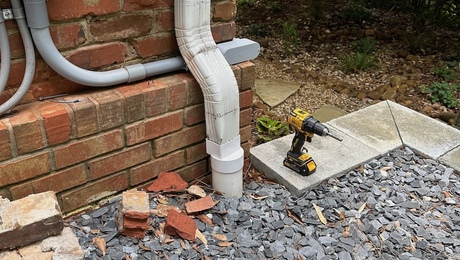
The flow restriction came at the bottom of the downspout, which you can see in the lead photo above and also below, with some annotations.

The two elbows add resistance to the flow of the water, which makes it harder to clear debris traveling with the rainwater.
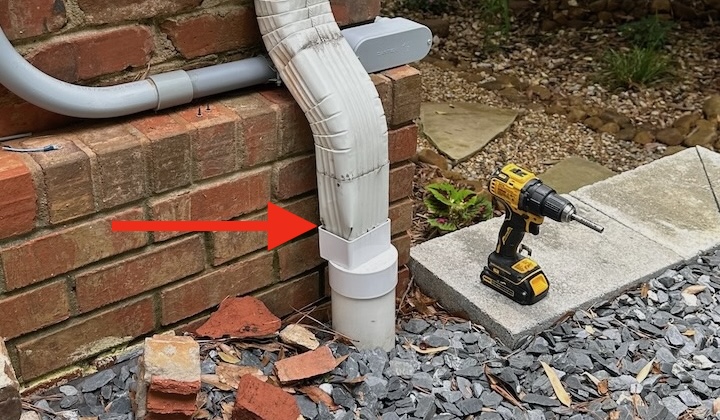
Then there’s this connection of the 4-in. x 3-in. downspout to the 4-in. pipe carrying the water away underground. You can see that it’s been crimped to fit into that connector. But wait! It gets worse.

The bottom piece was 6-in. of straight downspout. The right side of it was mangled to fit into the connector. But the connection between the straight piece and the second elbow also was bent inward. Ugh!

I forgot to take pictures of how bad it looked before I cleaned it, but you can see in the video above that the debris was packed tightly in there.
Preventing future downspout fountains
All I’ve done so far to fix this is clean it out and open up the area. You can see the result below.

But that’s not all I’ve got planned. Here are my next two changes:
- Better connection. The downspout still reduces the flow area at the connector, so I’ve started looking for a better connector.
- Gutter guards. I’ve resisted gutter guards because they’re often more trouble than they’re worth. Last year, though, I wrote an article about how building science begins outside the house. In the comments, I got some recommendations for a stainless-steel micro-mesh gutter guard. Several people said they work well so I’m going to test them on a few of our gutters.
I hope you never see this kind of unplanned downspout fountain at your house. But if you do, look for the restricted area somewhere below the fountain.
On the same day I saw the downspout fountain, I also saw a gutter waterfall. That one also had a clog in the downspout extender at the bottom. I cleared it and a couple days later saw the waterfall again. Turns out that downspout was clogged at top and bottom. I should have known that because it was spilling over the edge of the gutter.
All is well here now. We’re in the flow again. We have no water features of any kind.
Allison A. Bailes III, PhD is a speaker, writer, building science consultant, and the founder of Energy Vanguard in Decatur, Georgia. He has a doctorate in physics and is the author of a bestselling book on building science. He also writes the Energy Vanguard Blog. For more updates, you can follow Allison on LinkedIn and subscribe to Energy Vanguard’s weekly newsletter and YouTube channel.
Weekly Newsletter
Get building science and energy efficiency advice, plus special offers, in your inbox.