
Blog
18 HVAC Design Mistakes in Custom Homes – GreenBuildingAdvisor
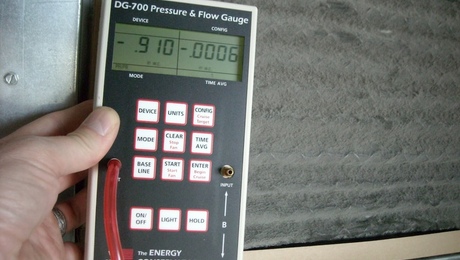
At Energy Vanguard, we’ve designed HVAC systems for thousands of homes across the United States. We’ve made our share of HVAC design mistakes, of course. And we’ve learned from them. We’ve also been in a lot of homes with HVAC systems designed by others and have seen some of their mistakes too. So let’s take a look at some of the things that get done wrong in the design phase. If we don’t know how things are going awry, it’s hard to make them right.
As the title states, this article is about HVAC design mistakes. I’ve covered a lot of installation mistakes in other articles, but here I’m focusing on the plans and specifications handed to the installer.
1. Oversizing the heating and cooling system
I’ve been writing and speaking about oversized HVAC systems since I started my blog in 2010. Oversized heating and cooling systems are bad for comfort and humidity control. And with variable capacity systems, it can be even worse. Adam Mufich of the National Comfort Institute put it best: “The most expensive fixed-capacity system you can buy is an oversized mini-split.” Yep! Here’s what I wrote about that.
2. Undersizing the ducts
When you specify duct sizes that are too small, you probably won’t get the airflow you need. That can make rooms uncomfortable. It also can make the system noisier and more likely to freeze the air conditioner coil or crack a heat exchanger. That’s because the increased resistance in the duct system can reduce the airflow, which makes the AC coil colder and the furnace heat exchanger hotter. Real duct design can make a huge difference. (We do that.)
3. Oversizing the supply registers
In contrast to duct sizing, the supply registers are usually too big. That makes it easy for installers who like to use the same register for almost every vent. But it’s bad for getting the air to mix well in the living space.
4. Undersizing an ERV or HRV
On the too-small side again, ERVs and HRVs often get sized for the continuous airflow rate needed. But that’s bad for three reasons. If you need a continuous airflow rate of 100 cubic feet per minute (cfm) and you put in a 100 cfm ERV, you have no room to boost the system to a higher rate for short periods. It’s also bad for efficiency. And it leaves you no room to increase the continuous airflow rate if you need to. So don’t size them for the continuous rate you need. Make them twice that size.
5. Not including ventilation
Undersizing an ERV is better than not specifying whole-house mechanical ventilation at all, though. Unfortunately, some building codes allow you to get away with that. Here in Georgia, for example, home builders don’t have to install whole-house mechanical ventilation unless the airtightness is less than 3 air changes per hour at 50 pascals (ACH50). Seems like a huge liability to me.
6. Ignoring framing details
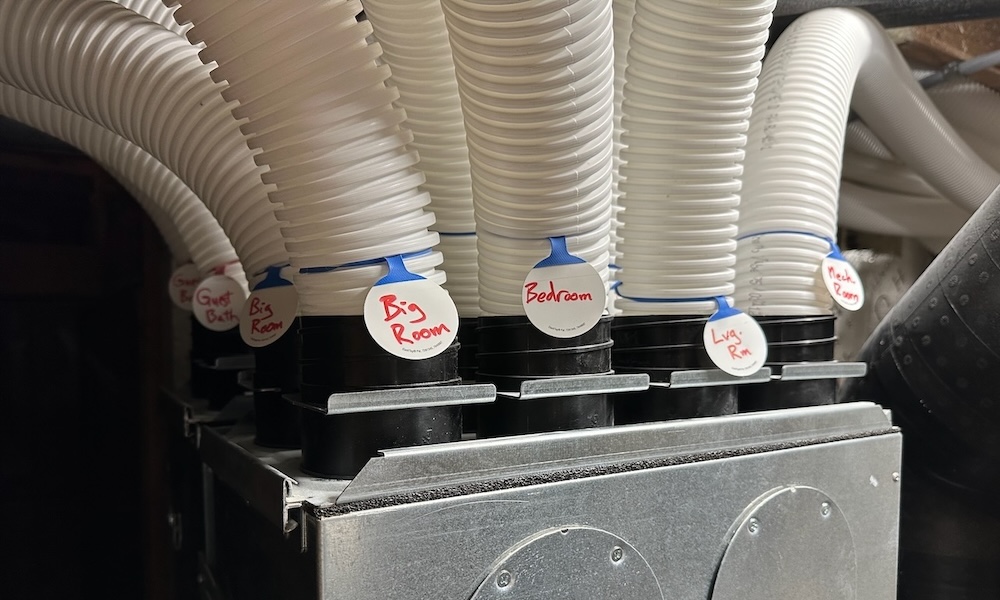
If an HVAC designer sends a design out that has ducts running through steel beams or other impossible places, it’s not going to work. The best-case scenario here is that the client comes back and tells them it won’t work and lets them fix it. But a lot of times the installer will just do what they can to get the ducts from point A to point B—even if they have to add four elbows or put flex duct through crazy contortions.
7. Not providing guidance for field changes
That last error brings me to this related HVAC design mistake. In our duct designs, we let the installers know what changes they can make on their own and which require us to recheck the calculations for the new configuration. Some things we don’t need to check include increasing or decreasing the straight length of a branch duct or making a duct larger. Adding fittings and making ducts smaller are changes we do need to check.
8. Zoning a system without paying attention to airflow
Let’s say you want one piece of equipment to serve three zones. You’ve got a design showing that the variable speed equipment can ramp down to a low of 600 cfm. But guess what? The smallest zone needs only 200 cfm of air at the design conditions. If that’s the only zone calling for air, it’s going to get all 600 cfm, which means it’s going to be noisy. It might also blow floor registers out of their boots. (Yeah, we made that mistake on a design a long time ago.) Zoning a system is tricky.
9. Calling for a bypass duct in a zoned system
Bypass ducts seem like they’d be needed because they provide pressure relief. When not all zones are calling for air, you’ve got to figure out some way to handle that excess pressure, right? Yes, but bypass ducts are the worst way to do it. They can freeze the coil, crack a heat exchanger, poison the occupants with carbon monoxide, and increase operating costs. The ways to eliminate the bypass duct are (1) zone with equipment, not dampers, or (2) balance the zones for similar airflows, use a variable speed system to reduce the excess pressure, and don’t let the zone dampers close completely.
10. Putting an ERV or HRV in unconditioned space
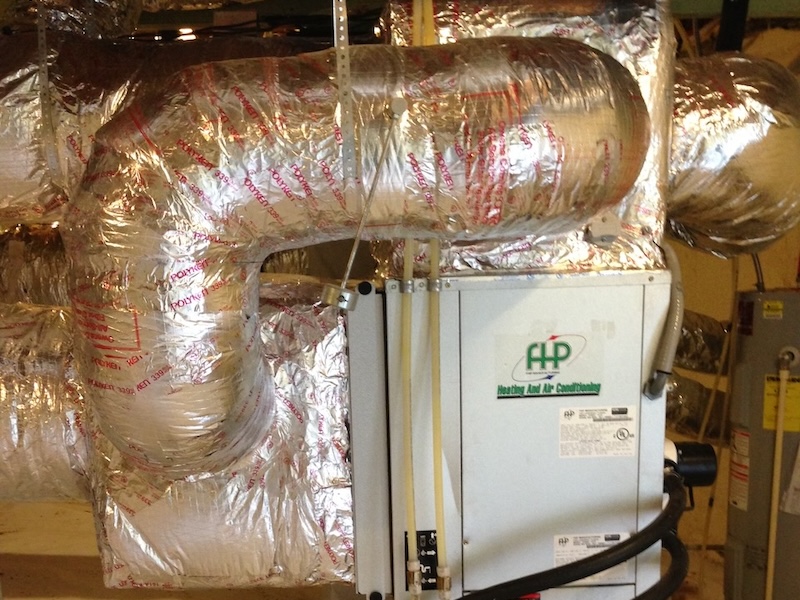
It should be obvious that an ERV should be in conditioned space. I’m pretty sure the installation instructions on all of them tell you to do that. You’ll kill the efficiency of the heat exchange if you put them in unconditioned space. This is one of the 11 ways to screw up an ERV installation that I wrote about recently.
11. Not specifying the airflow rate
Whether the HVAC designer is specifying fixed capacity, multi-stage, or variable capacity equipment, they need to put on the plans what airflow rate they’ve designed the ducts for. That’s because air handlers come with different airflow-rate settings. The duct sizes come from the airflow rate. The amount of heating, cooling, and dehumidification you get from the system also depends on the airflow.
12. Designing the HVAC for the wrong climate
That last one leads right into designing with the climate in mind. For example, in a dry climate, you want to design the cooling system for high airflow rates (e.g., 500 cfm per ton or more), and in humid climates you want low airflow rates (e.g., 350 cfm per ton). In some places you need supplemental dehumidification. Occasionally, we include humidification as well. In rare cases you might specify an HRV instead of an ERV (but most homes need an ERV, not an HRV). You’ve got to do the right things for each climate.
13. Connecting air handlers, dehumidifiers, and ERVs improperly
When you connect the ducts of different devices together, you have to understand not only airflow but also how air conditioners work. If you don’t, you could end up with two blowers fighting against each other. Or you could end up reducing the dehumidification capacity of your air conditioner.
14. Specifying a standard 1-inch fiberglass filter
The typical filter has about the lowest efficiency you get in a filter. With a filtration efficiency of about MERV-2, they don’t catch a lot. Add some filter bypass, and you’re letting a lot of dirt go through the whole system. Not only is it doing little to remove pollutants from the air, but it also can make the air worse. Dust gets caught on a wet air-conditioning coil, and now you’ve got a biology experiment causing your air conditioner to spew mold, bacteria, and other things into your indoor air. Good HVAC designers specify MERV-13.

15. Undersizing a high-efficiency filter
But just specifying a high-MERV filter isn’t enough. The higher the efficiency of a filter, the higher the resistance to airflow. So you also have to size it properly. Otherwise the filter, even when clean, can reduce airflow (in a system with a standard blower) or increase energy cost (in a system with constant airflow). The physics is simple: High-efficiency filters have higher resistance per unit of area, so you overcome that by giving them more area.
16. Ignoring the limitations of multisplit heat pumps
Just because you can put eight or more indoor units on one heat-pump outdoor unit doesn’t mean it’s a good idea. In a previous article, I pointed out six reasons to specify fewer indoor units for each outdoor unit.
17. Placing registers where they blow air on people
One of the cardinal rules of duct design is this: Don’t blow air on people. Yes, air blowing across your skin may feel good on a hot day, at least for a while. But if the air is cold and you’re just sitting, it can feel uncomfortable. And in winter, it can cause drafts that make you feel too cool.
18. Not designing return-air pathways
The last of the HVAC design mistakes I’m discussing here is overtly about airflow. But the more important reason to pay attention to return-air pathways is health. Pressure balancing is one of the seven steps to good IAQ that I’ve written about. (And if you want to go deeper and get some CEUs, you can take my online IAQ course.)
The lowdown on HVAC design mistakes
When a speed skater falls in the first lap of the Olympics, her chances of winning a medal are about as close to zero as you can get. The same is true with HVAC design mistakes. Even the best installation, commissioning, and operation can’t overcome the designed-in deficiencies of the system.
One important question to ask is this: Who is doing the HVAC design? If it’s the contractor and there’s no line item in the agreement you sign with them, that may mean they’re skimping on proper design. Many do.
Obviously I’m biased in favor of third-party HVAC design because that’s what we do. We’ve made our share of HVAC design mistakes over the years, and we’ve learned from each one. We have a really good team of HVAC designers now, and I can tell you that HVAC design isn’t something that turns out well if it’s just an afterthought.
Allison A. Bailes III, PhD is a speaker, writer, building science consultant, and the founder of Energy Vanguard in Decatur, Georgia. He has a doctorate in physics and is the author of a bestselling book on building science. He also writes the Energy Vanguard Blog. For more updates, you can follow Allison on LinkedIn and subscribe to Energy Vanguard’s weekly newsletter and YouTube channel.
Weekly Newsletter
Get building science and energy efficiency advice, plus special offers, in your inbox.