
Blog
The Limits of Industrial Thinking in a Site-Built World – GreenBuildingAdvisor
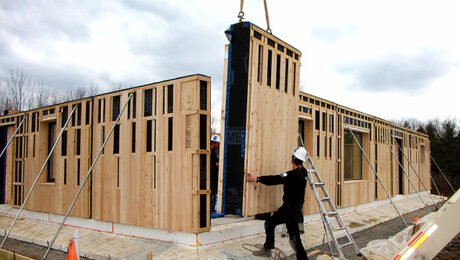
For more than a century, housing reformers, architects, and technologists have looked to manufacturing as the model for improving construction. The logic is straightforward: If industrialization made cars, appliances, and consumer goods dramatically cheaper and more reliable, why wouldn’t the same approach work for housing?
Brian Potter, of the Institute for Progress, recently published a piece in his Construction Physics newsletter titled The Elusive Cost Savings of the Prefabricated Home. In it he dove into the history of prefabrication as the primary vehicle for that idea—move work into factories, standardize components, reduce reliance on skilled labor, and capture the efficiencies of scale.
And yet as Potter painstakingly details, despite repeated efforts spanning early 20th-century experiments, postwar government programs, and more recent venture-backed startups, those expected cost savings have remained out of reach. Even the most optimistic results tend to land in the range of modest improvements, often on the order of 5%–20%, and frequently less in practice.
The typical conclusion is that construction has failed to industrialize. A more useful interpretation may be that we are asking the wrong question.
A Category Error
Manufacturing and construction are often discussed as if they are variations of the same problem. In reality, they operate under fundamentally different conditions.
Manufacturing takes place in controlled environments with standardized inputs, centralized decision-making, and highly repeatable outputs. Variability is minimized by design.
Construction, by contrast, is defined by variability. Every project is tied to a specific site, shaped by local conditions, regulatory constraints, and client-driven decisions. The work is distributed across teams and trades, each contributing to a system that must ultimately come together in the field.
Over the last century, prefabrication has been tested extensively across this divide. It has attracted significant capital, produced hundreds of thousands of homes, and in some cases reached…
Weekly Newsletter
Get building science and energy efficiency advice, plus special offers, in your inbox.

Sign up for a free trial and get instant access to this article as well as GBA’s complete library of premium articles and construction details.
Already a member? Log in