
Blog
Thoreau, Social Justice, and the Scientific Method – GreenBuildingAdvisor
This is my last scheduled article for Green Building Advisor; inevitably, I find myself in a retrospective mood. Over the years, I’ve worked as a builder, an investigator of moisture problems, and an editor.
For the last 30 years of my career, however, I’ve been a writer—someone concerned about the crafting of sentences and paragraphs.
A model of careful writing
Being in a retrospective mood, I find myself revisiting an old masterpiece of writing that I first fell in love with at the age of 16: Henry Thoreau’s Walden. Thoreau was a thinker and a nonconformist. He was suspicious of authority and inclined to pacifism. He was a master craftsman of the English sentence.
He was also a careful builder. Thousands of hippie carpenters and homesteaders have quoted his rhetorical question, “Shall we forever resign the pleasure of construction to the carpenter?”
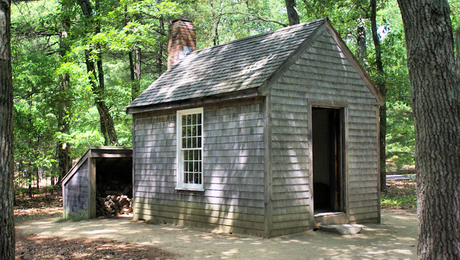
In 1845, Thoreau built himself a simple 10-ft. by 15-ft. cabin to live in; if a modern visitor were to enter this shelter, he probably wouldn’t even call it a house. He built the frame from young white pine trees that he cut near the building site, and he covered the frame with recycled boards and wood shingles purchased from the owner of a shack that had been demolished.
Here’s a telling detail, though: In describing the wall sheathing, he wrote that “the boards were carefully feather-edged [with a plane] and lapped, so that it was perfectly impervious to rain.”
What a nice detail! He took time to bevel the long edges of his wall boards, even though the sheathing would soon be covered with shingles: “Before winter I … shingled the sides of my house, which were already impervious to rain, with imperfect and sappy shingles.”
In effect, Thoreau’s wall was designed as a type of rainscreen. I like to imagine Thoreau sitting on the forest floor, running his plane along each sheathing board, creating his bevels. He had all the time in the world, and lots of patience.
Social justice
The green building community would do well to focus more of its energies on social justice. The occasional GBA article has given a brief nod to social justice—as, for example, in a 2017 article called “Fusing Green and Universal Design” and in a 2018 article called “What Makes a City Green?” but the inherent tension between “fine homebuilding” (often a code phrase for expensive housing) and social justice is rarely addressed on these pages.
Thoreau’s writing addressed social justice. In 1854, he wrote, “I cannot believe that our factory system is the best mode by which men may get clothing. The condition of the operatives [factory workers] is becoming every day more like that of the English [who were infamous for their exploitation of workers]; and it cannot be wondered at, since, as far as I have heard or observed, the principal object is, not that mankind may be well and honestly clad, but, unquestionably, that corporations may be enriched. In the long run men hit only what they aim at.”
As with clothing, so with housing. He wrote: “Granted that the majority are able at last either to own or hire the modern house with all its improvements. … But how do the poor minority fare? … The luxury of one class is counterbalanced by the indigence of another. … The mason who finishes the cornice of the palace returns at night perchance to a hut.”
Cornice installers of America! Does this ring true to you?
Housing affordability
In the U.S. today, we are facing a full-blown housing affordability crisis. The system is not working. This crisis is intimately tied to the problems of income inequality and wealth inequality.
Our country’s failure to address these three issues—the housing affordability crisis, income inequality, and wealth inequality—are likely to lead to a social explosion.
Some of us began calling ourselves “green builders” because we care about the environment. But there is no way to address environmental concerns without acknowledging that our work must focus on improving social justice.
On volunteering insights
It is a conceit of the elderly that younger people care about their opinions. Now that I’m 70 years old, I’m at that dangerous age where I may be tempted to volunteer my insights.
There’s a quote from Thoreau for that, of course. He wrote, “You may say the wisest thing you can, old man,—you who have lived seventy years, not without honor of a kind,—I hear an irresistible voice which invites me away from all that.”
If, like the young Thoreau, you hear more attractive voices than mine, you should certainly heed their call. Yet I still hope a few readers will take note of a topic that concerns me.
Here’s my concern: I am disheartened by our country’s growing contempt for the scientific method.
Science matters. Those of us who design and build houses depend on building science researchers to answer our technical questions. Over the past 50 years, much of this research has been conducted by national laboratories funded by the federal government.
Under the current Republican administration, these laboratories are being systematically dismantled. In the case of the premier climate science lab in the country—the National Center for Atmospheric Research in Boulder, Colorado—the Republican effort will include the literal sale of the building and the removal of the lab’s supercomputer. Why? It’s hard to say, but the White House budget director, Russell Vought, said that the climate lab in Colorado is “one of the largest sources of climate alarmism in the country.”
Once lost, the institutional memory (and collection of talent) in these national labs will take a generation to rebuild. In the meantime, as long-term research projects lose their funding, crucial data disappear.
As our national labs are being dismantled, a growing number of American parents distrust their pediatricians’ advice on childhood vaccines—a distrust that has contributed to a significant increase in measles cases.
So here’s my plea: If you’re in school, pay attention in science class. If you’re in government, defend the role of science in public health and public safety (including building performance).
Otherwise, if current trends continue, we are likely to enter a dark era of ignorance.
I’ve been lucky
On a more positive note, let me say that I look back at my career with very fond memories. I’ve rarely been happier than I was when I was 19 years old, sitting on a ridge installing cap shingles on a sunny day. What a great way to make a living!
The community of writers and editors I’ve been privileged to work with—at the Journal of Light Construction, Energy Design Update, BuildingGreen, Fine Homebuilding, and Green Building Advisor—have all been smart, funny, and relaxed. It’s been a privilege to work with them.
I’m retiring with a smile on my face.
— Martin Holladay is a retired editor who lives in Vermont.
Weekly Newsletter
Get building science and energy efficiency advice, plus special offers, in your inbox.