
Blog
Freeze Warning! The Result of Incompetence – GreenBuildingAdvisor
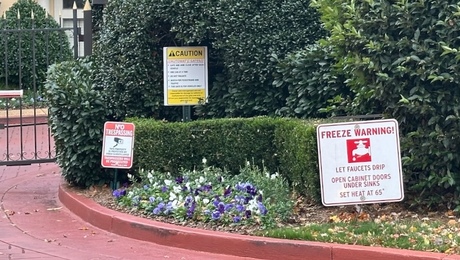
It’s “Freeze Warning” time of year again. We had our first freeze of the winter here in Atlanta a few weeks ago, and I saw the sign above. I cringe every time I see one of these signs that says, “Let faucets drip.” What’s worse is when those signs pop up in front of buildings with green building certifications. Yes, we have some of those here, and I drive by one on my way to the office. In either case, though, it’s hard to imagine a better way to broadcast the incompetence of the design and construction of the building.
And then many other companies that deal with homes send out advice like what you see below, which I got from my homeowners insurance agent around the same time.

I think this is mainly a Southern thing. People in cold climates generally know it’s a stupid idea to put water pipes in places that could cause them to freeze and burst. So I’m going to share some cold-climate “secrets” that will prevent pipes from bursting without the need to waste water and energy.
3 ways to protect your pipes from freezing
1. Get them completely inside the conditioned space. If freezes are a regular thing where you live, pipes need to be in the heated part of the house. Then the only way they can freeze is if you lose power and can’t heat the house.
2. If they’re in a vented crawlspace, encapsulate it. By air-sealing the crawlspace to isolate it from outdoors and insulating the foundation walls, you’ll keep the crawlspace much closer to the indoor temperature than the outdoor temperature. Then put a remote sensor for a digital thermo-hygrometer in the crawlspace to monitor the conditions.
3. Wrap the pipes with insulation and perhaps install heat trace cables. If it’s just not possible to get all the pipes into warmer conditions, pipe insulation may be all you need to keep them from freezing if you’re in a place that freezes only rarely. But often that’s not enough.

In a vented crawlspace that spends a good amount of time below the freezing point of water, you may need a little additional help. Heat trace cables are available to add heat to the pipe to make sure the water within doesn’t freeze. They’re just electric resistance strips you wrap around the pipe. Of course, you don’t want them on all the time, so make sure to get one that’s self-regulating. They issue and respond to their own freeze warning. They’re readily available online, so just search if you need them.
And definitely don’t do this!
At least water pipes in attics are uncommon north of central Florida, but bigger buildings have fire-suppression systems with sprinklers in ceilings. Some of those are “wet systems,” which are constantly pressurized with water. Those need protection from freezing. In fact, the fire code requires it. Using a dry system that lets water into the pipes only when necessary would be another way to prevent those pipes from freezing. (Here’s a good explanation of wet and dry systems.)
My mother-in-law lives in a retirement home with a wet sprinkler system. To keep the sprinkler system pipes from freezing, they’ve opened the attic hatches in the heated hallway. Ugh! That meets the fire code mandate of protecting the pipes from freezing but violates the fire code by having an open hatch that can feed a fire with oxygen.

So I got the contact info for the associate executive director and sent him an email about the increased risk of fire from having open attic hatches. I also told him about the safety issue and mentioned some of the relevant building and fire codes they were violating. The next time I went there, the attic hatches were closed. Now let’s see if they remember that lesson this year.
Stop the waste
I hate to think of how much water gets wasted by people leaving their taps running when those signs go out. Likewise with the amount of heating energy wasted when people think they have to keep the heat set to no lower than 60° or 65°F or try to heat an unconditioned attic. If the occupants are home, that’s not an issue. But no residence in a climate with freezing weather should need that much heat just to keep pipes from freezing.
So there. Freeze warning, schmeeze schmarning! Just steer around the incompetence and freeze-proof your pipes.
Allison A. Bailes III, PhD is a speaker, writer, building science consultant, and the founder of Energy Vanguard in Decatur, Georgia. He has a doctorate in physics and is the author of a bestselling book on building science. He also writes the Energy Vanguard Blog. For more updates, you can follow Allison on LinkedIn and subscribe to Energy Vanguard’s weekly newsletter and YouTube channel.
Weekly Newsletter
Get building science and energy efficiency advice, plus special offers, in your inbox.