
Blog
Eliminating Filter Bypass for Cleaner Air – GreenBuildingAdvisor
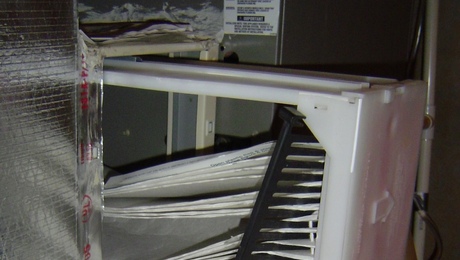
When it comes to the air moving through your HVAC system, filter bypass is not a good thing. The lead photo above shows a bad case of bypass. What you’re looking at is an old-style high-efficiency pleated filter. I don’t recall the exact depth, but it was certainly 4-in. or more. The big pleats were held apart by big combs (the black piece at the right side of the filter. Either the installer didn’t pay close enough attention or the filter collapsed for some other reason. The result, though, was a huge gap that allowed dirty air to bypass the filter.
Filter cabinets and grilles leak
The lead photo is unusual because that type of filter is uncommon. But filter bypass is extremely common. In my article about why filters often don’t improve indoor air quality, it was number 2 of the 7 reasons I gave. The majority of HVAC systems seem to have 1-in.-thick filters on the return side of the air handler. They fit into a sheet metal slot and then another piece of sheet metal covers the slot.
But those covered slots are far from airtight. The photo below shows a sizeable gap at the top of one such filter slot. Because it’s right next to the blower, the negative pressure is highest right there. That means any holes or gaps there will draw in more air than if they were farther from the blower.

Another common problem with this type of filter is that the cover is often missing. That’s the case in the photo below…and many, many others that I’ve seen.

Some HVAC systems are in closets inside the house. (Hooray for being in conditioned space!) On a trip to Florida, I saw one that had the poorly installed filter you see below.

Thicker filters with their own cabinets (like the ones AprilAire makes) are better for two reasons. First, the thicker filter is harder to bend like the one just above. Second, the cabinets are made to reduce bypass. The filter fits tightly, and the door and perimeter of where the filter sits have weatherstripping.
And that brings me to…
What about weatherstripping?
I haven’t tested or seen evidence of filter bypass in weatherstripped cabinets like the ones made by AprilAire. Nor have I looked. But I do have some experience with weatherstripping.
I’ve written several times about the high-efficiency filters in my house (most recently here). When I first got the system installed, I followed John Semmelhack‘s lead and used blue painters’ tape in the filter grille to eliminate bypass (photo below).
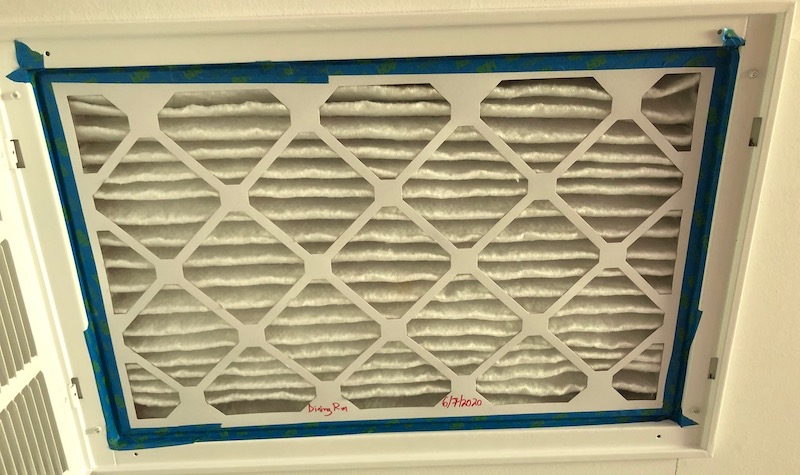
But taping a filter into a filter grille in a ceiling is a bit of a hassle. Taping takes more time than just popping the filter in there. It’s also difficult in a ceiling because of the weakest of the fundamental forces in the universe—this little thing called gravity. So, a couple of years ago, I installed weatherstripping in my filter grilles (photo below).

It made filter changes a lot easier. But how well has it worked?

Well, I just changed the filters a few days ago, and you can see above that there’s quite a bit of dust on the weatherstripping and the filter grille housing above the weatherstripping. That means I’ve got filter bypass because of the weatherstripping. What you see is the dirt that gut stuck there. I’m sure there was more that kept going all the way to the blower and coil of my heat pump. The dirt you see is what has accumulated over the 2.5 years since I put the weatherstripping in.
Tape is the winner
After removing the dust I found there, I installed new filters. I didn’t remove the weatherstripping because it does a great job holding the filter in place. But I did go back to taping around the edges again. Now my ducts, blower, and coil should stay cleaner.
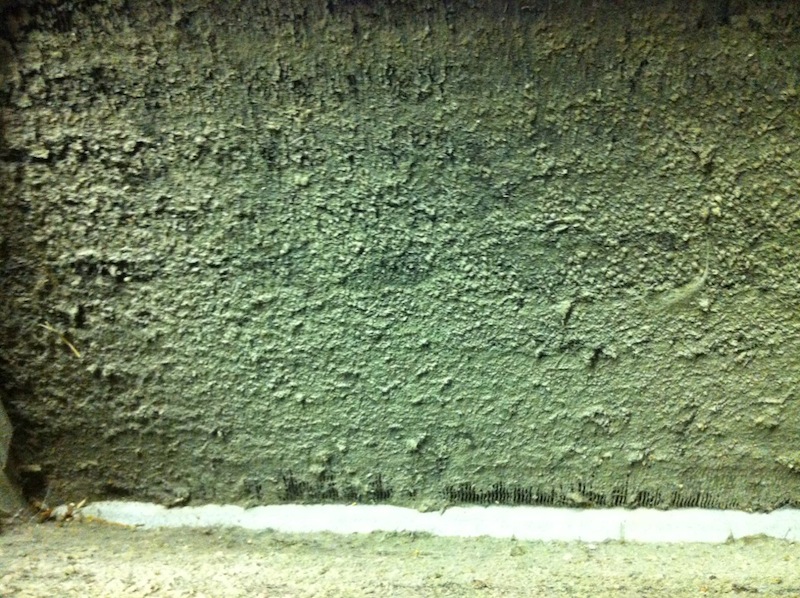
You don’t want filter bypass because it can make the ducts, blower, air conditioner coil, and furnace heat exchanger dirty. Some of those indoor air pollutants may make it all the way through the system and back into your indoor air. And a dirty coil can lead to microbial growth (photo above). The goal for filtration is to have all the air pass through a high-efficiency filter (MERV 13). That keeps everything clean, including your respiratory system.
Allison A. Bailes III, PhD, is a speaker, writer, building science consultant, and the founder of Energy Vanguard in Decatur, Georgia. He has a doctorate in physics and is the author of a bestselling book on building science. He also writes the Energy Vanguard Blog. For more updates, you can follow Allison on LinkedIn and subscribe to Energy Vanguard’s weekly newsletter and YouTube channel.
Weekly Newsletter
Get building science and energy efficiency advice, plus special offers, in your inbox.