
Blog
The American House: Where Did We Go Wrong? – GreenBuildingAdvisor
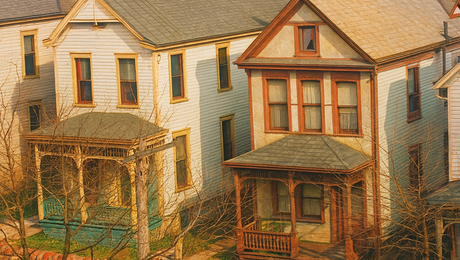
Editor’s Note: While digging through the Fine Homebuilding archives recently, I came across this 2011 article by Kevin Ireton, who was editor of FHB at the time. I remember reading it back then—it stuck with me. Nearly 15 years later, the piece still holds up and feels just as relevant today.
Please leave a comment if you feel a reprint of older but still significant articles from Fine Homebuilding should become a semi-regular Saturday post.
The houses we build today evolved in response to the availability of cheap fossil fuels. That’s why you can routinely find new houses in Texas with air-conditioning systems installed in uninsulated, 140ºF attics and homes in New England with no windows on the south side. There are two problems with building this way. The first is simple: Fossil fuels are a finite resource. We’re going to run out of them.
The second problem is more complicated, and more controversial: Powering our houses with fossil fuels is damaging the planet, whether from mountaintop removal of coal, oil spills in the Gulf, or global warming. The environmental problems may be too abstract or too frightening or too politically charged for many to acknowledge; however, we can all agree that the costs of gasoline, propane, natural gas, fuel oil, and electricity are going up. Whether you’re focused on diminishing supplies of fossil fuels, damage to the environment, or damage to your bank account, the necessary response is the same: We need to build better houses that are less dependent on fossil fuels.
Ironically, we already know how to do that. Unlike the car industry, which is mostly chasing improvements in fossil-fuel economy, the home-building industry has the technology and the knowledge right now to build houses that use little or no fossil fuel. Off-the-grid houses, net-zero houses, and passive houses have proven what’s possible and shown the ways to achieve it. Now the chief question is this: How do we get from here to there? While I can’t necessarily answer that question completely, I can begin by looking back and trying to understand how we got here in the first place.
Connecting to utilities, disconnecting from consequences
Before the Civil War, most of the houses in this country were built of local materials. They were heated by fireplaces or cast-iron stoves that burned wood or coal. Lighting came from candles, oil lamps, and the sun. Water was carried in and out. Backyard privies and chamber pots dealt with human waste. Compared to most homes today, these antebellum houses were pretty green and pretty sustainable (if decidedly less comfortable). All of that changed over the next 100 years.
The explosive growth of the railroads, including the completion of the transcontinental line in 1869, meant that lumber and other building materials could be shipped all around the country. As soon as milled lumber was available, log and timber construction declined. Homesteaders on the Great Plains abandoned their straw-bale and sod houses. By the turn of the century, Sears was shipping doors, windows, and sinks all over the country. In 1908, the company started shipping entire precut homes. But while the railroads connected houses to sawmills and to manufacturing plants, it was another series of connections that really began to change how we lived.
In the late 1880s, J.P. Morgan and Thomas Edison, in the form of General Electric, were battling George Westinghouse and Nicola Tesla for dominance as America’s electrical supplier. Edison advocated direct current (DC), claiming it was safer—a fact he demonstrated by publicly electrocuting stray cats and dogs with alternating current (AC)—and because he held patents on lots of DC-related equipment. Westinghouse promoted alternating current because its voltage could be stepped up via a transformer and be transmitted long distances without crippling line losses. Edison’s DC power plants had to be within a mile or so of the loads they served.
The debate was settled in 1893 when Westinghouse won the contract to build a hydroelectric generating plant at Niagara Falls. Completed in 1896, the Adams Powerhouse No. 1 successfully sent power to the city of Buffalo, 20 miles away.
Within a few years, electric lighting was common in cities. Gas companies, which had been the first residential utilities, started marketing their product for home heating. Once electricity had a foot in the door, manufacturers were quick to find uses for it. Electric sewing machines and fans came first, but vacuum cleaners, washing machines, irons, toasters, and coffee percolators soon followed. By 1920, you could order any of these things from Sears or Montgomery Ward.
“We live, like it or not, on the far side of a great technological divide.” So says architect and writer Witold Rybczynski in his book Home: A Short History of an Idea (Penguin, 1986). “The evolution of domestic technology … can be divided into two major phases: all the years leading up to 1890, and the three following decades.” By the 1920s, our houses had running water, bathrooms, electricity, and central heating. Modern, car-dependent suburbs were beginning to spring up outside major cities, and the American home’s dependence on fossil fuels was under way.
How the New Deal squelched renewable energy
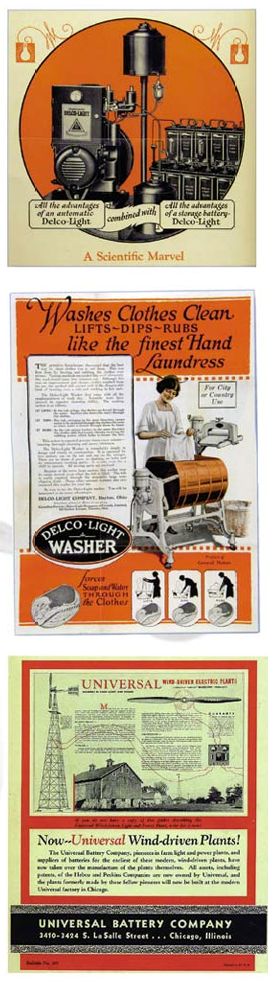
In the first decades of the 20th century, electricity came quickly to urban homes and not at all to rural ones. Running miles and miles of power lines out to farmers and others in remote areas was just too expensive. In 1910, over half the country (nearly 50 million people) lived without electricity. Charles Kettering wanted to change that. After developing the electric starter for the automobile and selling his company, Delco, to General Motors, Kettering introduced the Delco-Light Farm Electric Plant in 1916. It was a small gas-powered engine coupled to a generator and a set of batteries. He also developed a line of lights, well pumps, and appliances to run off the machine’s 32v direct current. Farmers could even buy an electric motor on a tripod, called the “power stand,” that used pulleys and belts to drive everything from washing machines to grindstones.
Within five years, Delco-Light had sold more than 175,000 units. A few years later, they were competing with 72 companies selling farm electric plants (a figure that would more than double by 1935). Meanwhile, 1400 miles west of Delco’s Dayton, Ohio, plant, a bunch of radio enthusiasts were giving birth to the renewable-energy industry.
According to Craig Toepfer’s The Hybrid Electric Home (Schiffer, 2010), the first wind generators were made by Great Plains farmers whose living-room radios were hooked up to car batteries that they got tired of lugging into town to be recharged so that they could hear the Clicquot Club Eskimos, the Ipana Troubadours, or WLS’s National Barn Dance. They mounted homemade propellers onto car generators, stuck them on a pole, and wired them to their radio batteries.
Eventually, more than 20 companies made wind generators. One of the best known, the Jacobs Wind Electric Co., opened its first factory in Minneapolis in 1930. Although M.L. Jacobs and his brothers set out to compete with Delco-Light, many wind generators got hooked up to farm electric plants to save fuel, creating the first hybrid generators.
Toepfer argues that this nascent industry of off-the-grid power generation was destroyed, or at least “stifled and held irrelevant for the past 90 years,” by the Rural Electrification Act of 1936. He writes, “In a monumental act of irrationality, justifiable only by a lack of knowledge or understanding, the federal government decided to do what no investor-owned utility would even begin to consider doing, extending the central station wires from the major urban centers to every rural and remote part of the nation.” Once wires reached a farmhouse, “the REA required wind and farm electric systems to be removed or destroyed before the agency allowed them to connect.”
“This policy and program,” Toepfer writes, “was one of the most significant mistakes made in the development of our electric supply network.” Part of the problem was that electric utilities were regulated monopolies, with prices fixed by the government; hence, “the pathway to maximum profitability was to increase demand.” With the whole country wired to the grid, utility companies soon began to promote the all-electric house. The other big problem is that generating electricity with fossil fuels is not a very efficient process. By the time electricity reaches our homes, 70% of the coal, gas, and oil used to create it has been wasted through heat released into the atmosphere.
There’s no question that rural electrification improved the lives of millions of Americans. But for the same money ($210 million), Toepfer says, the government could have bought a farm electric plant and a wind generator for those same homes with money left over. Instead, we put all our eggs in one energy basket, committing the country to an inefficient electrical grid, sanctioning tremendous environmental damage in the process, and squelching what could have been an enormous head start for alternative energy.
Air-conditioning killed the porch, among other things
Before 1910, most American homes didn’t have central heating. That began to change in 1915 when William J. Doyle, of the Caloric Furnace Co. in Cincinnati, patented the “pipeless furnace.” Basically, it was a parlor stove installed in the basement, which moved the associated mess of hauling fuel, stoking fires, and clearing ashes out of the living room. It was “pipeless” in contrast to the steam and hot-water systems that the wealthy had been enjoying for some years. But even as central heating improved with the development of small electric fans and pumps, it never affected the design of our houses as much as its counterpart: central cooling.
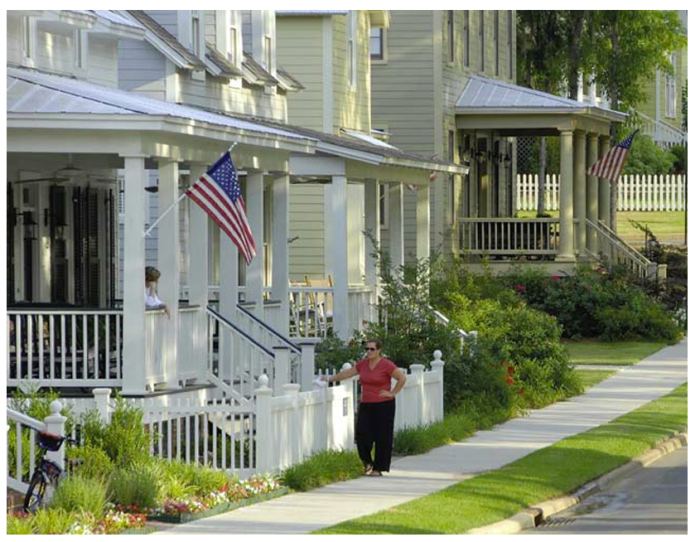
Since the earliest days of this country, houses in the South evolved in response to the oppressive heat. In the arid Southwest, the response was thick adobe walls and small windows. In the Southeast, it was high ceilings, tall windows, and central hallways with doors at each end. Likewise, houses were elevated on posts and piers to promote air circulation under the floors, which led to what we know today as the crawlspace foundation. But the most important architectural response to the heat was the porch. According to Virginia and Lee McAllister, “The use of large porches expanded until, by the late 19th and early 20th centuries, they had become an almost universal, and quite distinctive, feature of American domestic architecture.” The McAllisters, authors of A Field Guide to American Houses (Knopf, 1984), go on to say that this trend was completely reversed by the mid-20th century.
The first central air-conditioning system was installed at the New York Stock Exchange in 1902. Frigidaire made the first room air conditioner in 1929, and two years later, the company introduced central air-conditioning systems for homes. The first window air conditioner was marketed by Philco in 1938. But it wasn’t until 1959, Stan Cox writes in his book Losing Our Cool (The New Press, 2010), “that the price of air-conditioning dropped to the point that a builder could cool an entire house for the cost of adding a Florida room.”
Unfortunately, Florida rooms (big screened porches) weren’t the only things eliminated to offset the cost of A/C. Across the country, “home plans were stripped of heavier construction materials, movable window sashes, screens, storm windows, large eaves, high ceilings, cross ventilated designs, and attic fans (the elimination of which also allowed cost-saving reductions in hallways and the pitch of roofs). Shade trees were bulldozed to ease builders’ access to the construction site. With central air to keep the house cool, contractors could use lighter, cheaper building materials in smaller quantities while leaving off extra insulation or other energy-conserving features; after all, it wasn’t the architects or builders who’d be paying the later utility bills.”
In 1960, only 12% of American households had air-conditioning, mostly window units. But by 2005, 82% of our homes were artificially cooled, the majority with central air. Cox says that “the average air-conditioned home consumed 37% more energy for cooling in 2005 than it had only 12 years earlier … Part of that increase can be attributed to more widespread adoption of central air-conditioning and part to the growing square footage of houses and apartments. The bottom line: Energy consumed by residential air-conditioning almost doubled from 134 to 261 billion kilowatt-hours, in just 12 years.”
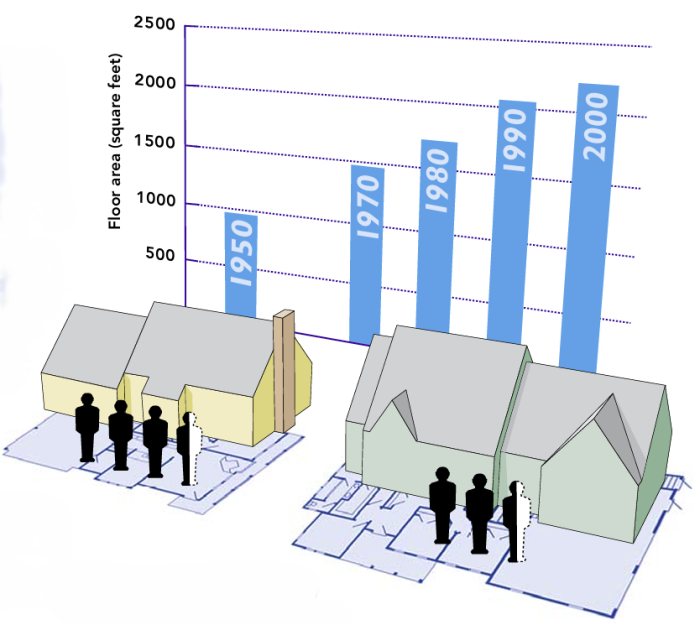
Between 1950 and 2000, the size of the average house more than doubled (from 983 sq. ft. to 2266 sq. ft.), the number of people living in the house went down (square footage per capita went from 286 in 1950 to 847 in 2000), and the percentage of homes with central air-conditioning went from essentially 0 to 82%. At the same time, we ignored passive-cooling strategies that were once routine and put most of the air-conditioning units in uninsulated attics.
We got serious about insulation in the 1970s
New Englanders in Colonial America stuffed rags and old newspapers into their walls to plug holes where cold air got in, and they piled leaves against the foundation in the fall as insulation for the winter. Some filled walls with chopped straw or eel grass, and Count Rum ford experimented with using feathers and fur as insulation. For the most part, though, our exterior walls did not start to fill up with insulation until the 1920s. Samuel Cabot (of Cabot Stain fame) was among the first to manufacture and sell insulation. Having heard about those thrifty New Englanders, he introduced Cabot’s Quilt in 1893, which featured layers of eel grass sandwiched between sheets of heavy paper.

insulation made with
eel grass.
According to a 1931 article in American Building & Building Age (the Fine Homebuilding of its day), there were at least 40 companies manufacturing thermal insulation at that time. Among the materials used were cork, gypsum, asbestos, limestone, rock wool, peat moss, wood shavings, and even combinations of vegetable fiber and animal hair. Modern fiberglass arrived a few years later, when Dale Kleist, a researcher for Corning Glass, accidentally hit molten glass with a stream of compressed air. In 1938, the Owens Illinois Glass Co. merged with Corning Glass to create Owens Corning and start producing “fiberglass.” But we didn’t get serious about using it (or any other insulation) until the 1970s.
The price of oil had been relatively stable since the end of World War II, and for the most part, so had the price of coal, gas, and electricity. But as a result of the Arab oil embargo in late 1973 (Arab countries were upset with our support of Israel), the price of oil quadrupled. And prices climbed steadily for the remainder of the decade, spiking again in 1980 as a result of the Iranian revolution. The price of other fossil fuels pretty much followed suit.
As a nation, we were shocked. We took cheap energy for granted, even though our consumption had been exceeding production for more than 10 years. And our own oil reserves had peaked three years earlier, leaving us increasingly dependent on foreign oil. A month after the oil embargo began, President Nixon announced Project Independence and committed the United States to becoming energy independent by 1980.
The 1970s spurred lots of research into energy-efficient construction, some of the most promising done at the University of Illinois at Champaign-Urbana. It was there in 1976 that a researcher named Wayne Schick coined the term “superinsulation” to describe his “Lo Cal House” (as in low calorie). This demonstration house, the first of its kind in the United States, featured double-stud walls with R-30 insulation, another R-38 in the roof, and energy bills that were one half to two-thirds of a typical house.
In Canada, the Saskatchewan Conservation house, built in 1977, boasted walls insulated to R-44. Two years later, at the Fairview Conference on energy and housing, Harold Orr, one of the designers of the Saskatchewan Conservation house, told his audience that “in this very severe climate … we can build houses that use 10% of the energy of a conventional house … Perhaps the most cost-effective thing a person can do in building a new house is simply to face it so that most of the windows face south.” He also advocated for the minimum amount of framing lumber because “every extra 2×4 put in is a place that can’t have insulation.”
But Orr made it clear that insulation alone wasn’t the answer: “Every dollar spent making houses more airtight is worth 10 times as much as every dollar spent on adding more insulation to the house.” He also poked fun at the use of fiberglass insulation to stop air leaks. “The same company that makes that pink insulation makes fiberglass air filters for the furnace,” Orr told the audience. “I don’t know why one would want clean air in the attic, but this seems to be the way we do it.” (If any of this sounds familiar, it’s because building scientists like Joe Lstiburek have been saying it in this country ever since and because the German Passivhaus movement, which built on this early research, is also echoing Orr’s words.)
In the 1970s, the Weatherization Assistance Program was launched to help low-income families lower heating bills by caulking, weatherstripping, and insulating. The Council of American Building Officials wrote the first model energy code. Researchers at Princeton developed the blower door to test for airtightness. Builders started using 2×6 wall studs to gain room for insulation. Some true stalwarts even built their own heat-recovery ventilators.
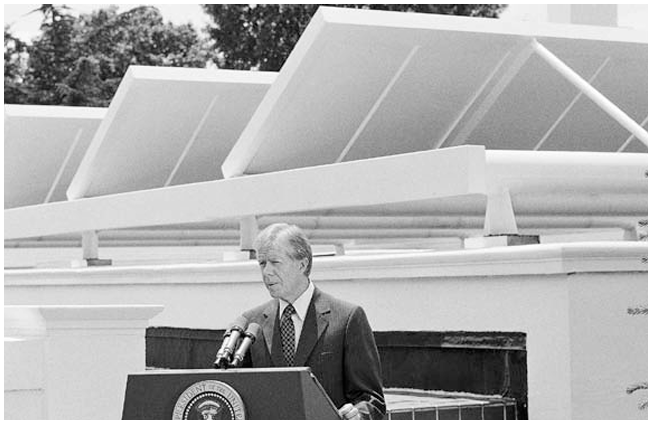
President Carter established the Department of Energy in 1977. Two years later, he held the first and only press conference on the White House roof to announce installation of solar water-heating panels. The following year, Carter signed the Energy Security Act, which promoted the development of biofuels, solar power, and other renewable energies.
In the 1980s, we dropped the ball
It’s not true that no advances have been made in energy-efficient construction or renewable energy since 1980, but Martin Holladay, a journalist and former builder (and retired editor of Green Building Advisor) who has been following energy issues for 30 years, says the 1980s are when we “dropped the ball.” Like many people, Holladay is quick to point a finger at Ronald Reagan, who reacted to falling oil prices by removing price controls and import limits on oil, cutting funding for research on alternative energy, and famously taking the solar panels off the White House roof in 1986. Alex Wilson, founder of Building Green and Environmental Building News, agrees.
“Perhaps the major failure,” Wilson says, “was the fact that we didn’t incentivize energy conservation and efficiency back in the 1970s through higher energy taxes, as the Europeans did. Significantly higher energy prices would have driven more compact (less car-dependent) development patterns, higher levels of energy performance, and widespread adoption of passive-solar design and solar water heating. By lessening our dependence on foreign oil, this would also have strengthened our nation.”
Architect Bob Berkebile, a key figure in today’s green-building movement, suggests that other factors also contributed. Berkebile was the founding chairman of the AIA’s Committee on the Environment, served on the board of directors of the U.S. Green Building Council, and was instrumental in the development of LEED.
“There were a number of iconic solar projects done in the ’70s that didn’t work and that really hurt the whole movement. Builders heard about the failures, and word spread like wildfire through the industry. … But the real killer, in my mind, was the affluence that came in the ’80s and ’90s. Everything got ‘supersized.’ We believed we should live in a bigger house in the suburbs and that it was part of our quality of life.”
Energy today is just so easy to waste
Whatever the reasons, there’s no question that in the 1980s, we lost the momentum propelling us toward more energy-efficient houses in the previous decade. It would be another 20 years before we got it back, and the circumstances would be different.
“What you had in the ’70s was a manufactured crisis,” says architect Ed Mazria, founder and CEO of Architecture 2030 and author of The Passive Solar Energy Book (Rodale Press, 1979), referring to the oil embargo. “As soon they turned the spigot back on, we went back to business as usual.” But today’s crisis is different. Oil prices are rising again. Terrorism is a reality now, not just a threat. We have peak oil and climate change to contend with. “These issues are not going away and can’t be controlled by turning the spigot on and off. They are with us until we solve them,” Mazria says.
Tremendous good has come into our homes, and into our lives, through wires, pipes, and ducts. We are safer, healthier, better educated, more easily entertained, and far more comfortable. But hooking up—to water mains, sewers, gas lines, and the electric grid—also fundamentally disconnected us from any direct knowledge of the efforts required to extract and deliver the resources we depend on and the effects of doing so. Our grandparents and great-grandparents, who had carried water, shoveled coal, and emptied chamber pots, valued these services accordingly. Over the course of 100 years, though, we’ve come to take them all increasingly for granted, resulting in a culture of waste.
Whether we elect to change our ways, and how quickly we do so, remains to be seen. But it’s clear from our history that change does not depend on new knowledge or new technology. We have known for a long time how to build houses that require less fossil fuel.
Reprinted from Fine Homebuilding Magazine, December/January 2011, Issue 216
Kevin Ireton, editor at large, is a freelance writer and carpenter in New Milford, Conn.
Weekly Newsletter
Get building science and energy efficiency advice, plus special offers, in your inbox.