
Blog
The Basics of Clean Air Delivery Rate – GreenBuildingAdvisor
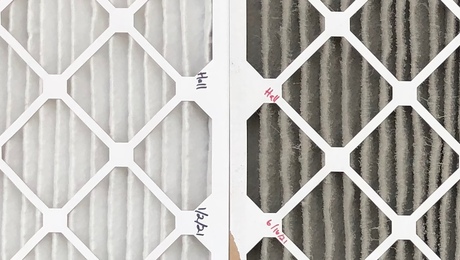
Let’s take the next step in understanding filtration efficiency today and talk about clean air delivery rate. You know that the really small particles, especially those that are 2.5 microns and smaller (aka PM2.5), are the most important indoor air pollutants to remove. And you know that, of the three filter rating systems, you want one rated on the 1-to-16 MERV scale. Here’s a video of me singing the filter rating song—or at least it looks like I am:
Further, you understand that MERV 13 filtration gives you a good balance between filter efficiency and minimizing resistance to airflow. Of course, you also realize that to use MERV 13 filters effectively, you need to size them properly. So what is this thing called clean air delivery rate (CADR)?
What CADR was made for
Clean air delivery rate is actually an official rating system for portable air cleaners. The Association of Home Appliance Manufacturers (AHAM) developed the ANSI standard that manufacturers use for testing air cleaners. So it’s like the efficiency ratings you see on air conditioners (SEER), heat pumps (SEER and HSPF), water heaters (UEF), and other appliances. Unlike those types of ratings, though, this one is voluntary.
The first thing to know about CADR is that it’s based on the effectiveness of removing particles in three different size ranges. Here are the size ranges and the names AHAM gives them:
- Smoke 0.09 to 1.0 microns
- Dust 0.5 to 3 microns
- Pollen 5 to 11 microns
And for reference, the MERV scale measures filtration efficiency in almost the same ranges, as you can see below.
- 0.3 to 1.0 microns
- 1.0 to 3.0 microns
- 3.0 to 10.0 microns
Air pollutants come in two varieties: particles and gases. Particles are conglomerations of molecules all stuck together. Gases consist of individual molecules. The CADR rating applies only to particle removal.
The meaning of CADR
Here’s what the AHAM website says about CADR:
CADR indicates the volume of filtered air an air cleaner delivers, with separate scores for tobacco smoke, pollen and dust. The higher the CADR number for each pollutant, the faster the unit filters the air.
In other words, it’s the airflow rate for an air cleaner but adjusted for the amount of pollutants removed. For example, if you have an air cleaner that operates at 100 cubic feet per minute (cfm) and it removes half of the particles in the smoke size range, it has a CADR of 50 cfm for those particles.
As an example, Honeywell had its HPA060 air cleaner tested and certified to the AHAM standard. The CADR ratings are:
- Smoke 48 cfm
- Dust 62 cfm
- Pollen 75 cfm
Why do the ratings improve as the particles get larger? Because larger particles are easier to catch.
A word of caution: The CADR numbers that manufacturers put on the label usually apply to the highest airflow rates. The problem with that is noise. Most people don’t want air cleaners making much noise, so they don’t run them at the highest rate—and thus don’t get the posted amount of particle removal. With a 7-step approach to good indoor air quality, though, you shouldn’t need to use the highest rates.
What about noncertified air cleaners?
Here’s one way you can use the CADR concept to compare a MERV-rated filtration device to commercially available air cleaners. You just need the filtration efficiency for the MERV rating of your filters (table below) and the airflow rate going through the filter to calculate your own CADR. It’s not an official, certified rating, but it can be helpful.
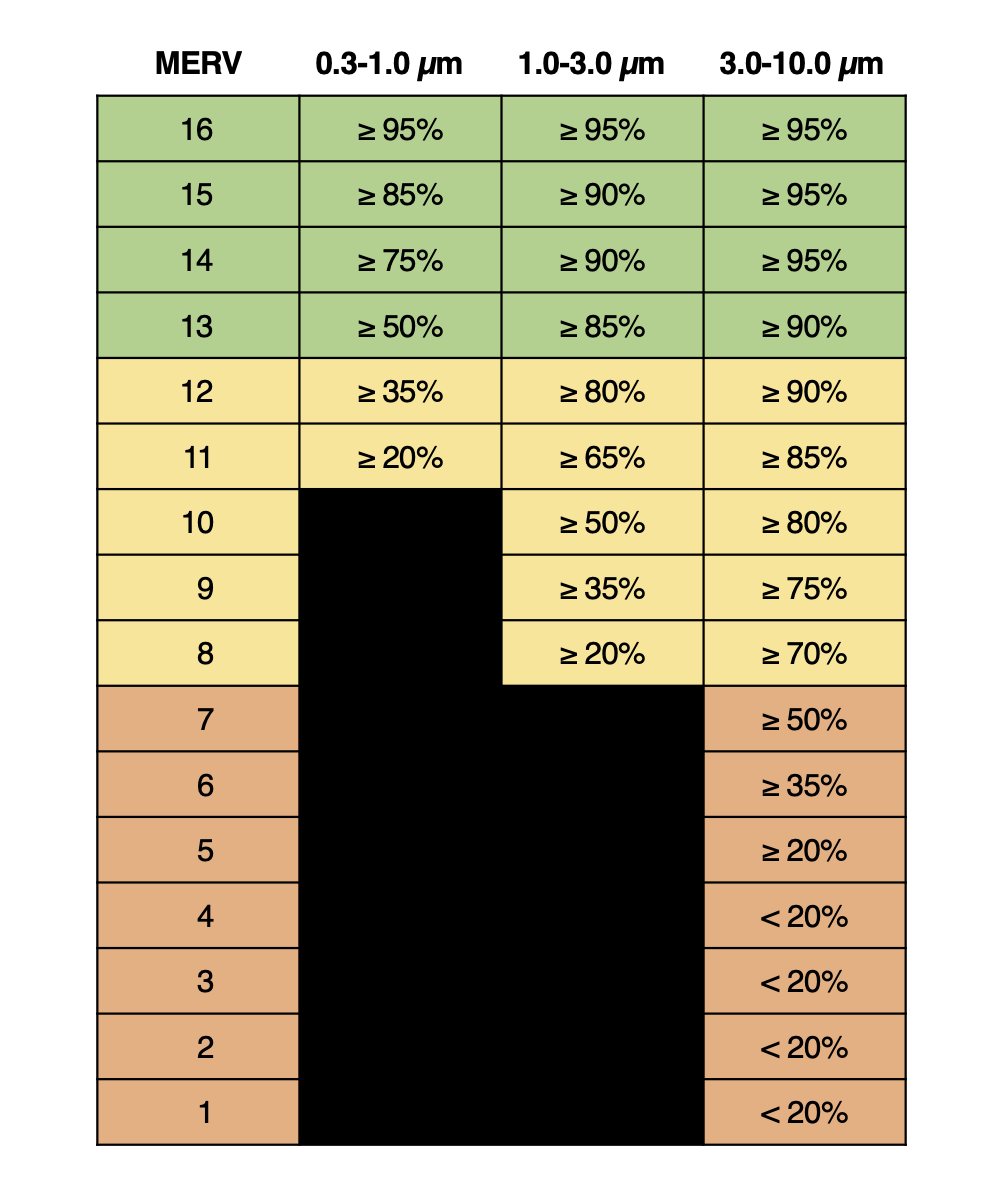
Let’s say you have a MERV 13 filter in your heating and air-conditioning system that operates at an airflow rate of 600 cfm. All you have to do is multiply the airflow rate—600 cfm here—by the decimal form of the efficiency in the table above. Here’s what they’d be in this example:
- 0.3 to 1.0 microns: 600 cfm × 0.5 = 300 cfm CADR
- 1.0 to 3.0 microns: 600 cfm × 0.85 = 510 cfm CADR
- 3.0 to 10.0 microns: 600 cfm × 0.9 = 540 cfm CADR
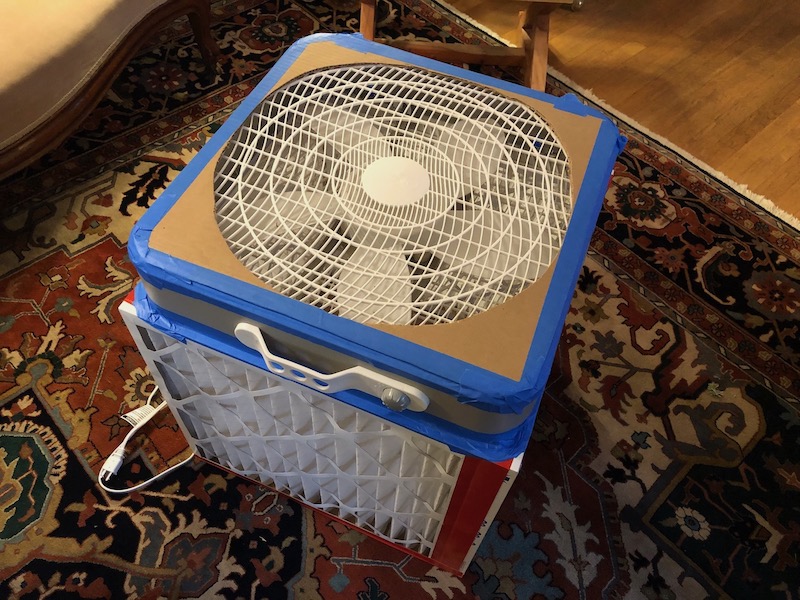
The DIY box-fan air cleaner (aka Corsi-Rosenthal box) has a high CADR compared to many commercially available air cleaners. John Semmelhack and Neil Comparetto tested the airflow on these homemade air cleaners in several configurations. For one that’s used a lot, airflow measurements result in these CADRs:
- 0.3 to 1.0 microns: 298 cfm × 0.5 = 149 cfm CADR
- 1.0 to 3.0 microns: 298 cfm × 0.85 = 253 cfm CADR
- 3.0 to 10.0 microns: 298 cfm × 0.9 = 268 cfm CADR
And that’s on low speed, which is where most people keep these DIY air cleaners set to minimize noise. On high speed, the airflow rate is 455 cfm and the CADRs would be 228 cfm, 387 cfm, and 410 cfm.
How to use CADR in your home
You may be thinking, “That is all well and good, but what do I do with that information?” Well, you can use it to see if you have an air cleaner sized appropriately for the room you’re using it in. AHAM says, “The CADR of your air cleaner should be equal to at least two-thirds of the room’s area.”
AHAM doesn’t say which size range you should use with that rule of thumb, though. And it also doesn’t say that if you run the air cleaner at a lower speed, the CADR will be lower too.
A better way to think about it is in terms of air changes per hour. Experts in the field of infectious disease, many of which spread through airborne transmission, recommend 5 air changes per hour of clean air delivery. That could be a combination of ventilation with outdoor air, filtered air, and air cleaned by some other proven method, like ultraviolet irradiation.
Air-change calculations
What’s an air change, you ask? It’s what happens when your air cleaner, say, delivers an amount of clean air that’s equal to the volume of the room. If your room is a 10-ft. square, for example, and the air cleaner has a CADR of 250 cfm, the calculation isn’t hard.
The volume of the room is 10 ft. × 10 ft. × 10 ft. = 1,000 cubic feet (cf). The air cleaner delivers 250 cfm of clean air, meaning that it delivers 1,000 cf of clean air in 4 minutes. That’s 1 air change per 4 minutes. Since 4 × 15 = 60, the result is 15 air changes per hour from the air cleaner.
That’s a lot! In fact, it’s more than you need unless you’re doing something that’s putting a lot of particles into your air. So you can either run the air cleaner intermittently or turn down the airflow rate. Or you can get a smaller air cleaner. To get 5 air changes per hour in a 1,000-cf room, you’d need an air cleaner with a CADR of 83 cfm.
Another option would be to buy a bigger house! Then you could take full advantage of that extravagant CADR. Just kidding—getting a bigger house is mainly for avoiding divorce.

The main point, though, is that you want good filtration in your home to clean the air. Do you have that?
Allison A. Bailes III, PhD, is a speaker, writer, building science consultant, and the founder of Energy Vanguard in Decatur, Georgia. He has a doctorate in physics and is the author of a bestselling book on building science. He also writes the Energy Vanguard Blog. For more updates, you can follow Allison on LinkedIn and subscribe to Energy Vanguard’s weekly newsletter and YouTube channel.
Weekly Newsletter
Get building science and energy efficiency advice, plus special offers, in your inbox.