
Blog
New Product: Smartrock – GreenBuildingAdvisor
Insulating exterior walls constructed of brick, block, and concrete can be daunting. Most building science professionals suggest that the insulation be located on the exterior of the structure. This helps thermal performance and can improve moisture management if the details are carefully planned and implemented. Building Science Corp. has a great article on the topic called Deep-Dish Retrofits. That being said, there can be challenges associated with that strategy, such as maintaining the historical façade of older structures and zoning requirements for setbacks, a potential issue when a building’s exterior size grows from added exterior insulation.
Insulating these same walls on the interior includes more risk due to moisture issues; after all, most structures built from brick, concrete masonry units (CMU), and poured concrete work on storage and redistribution principles for their moisture management. They get wet, and the moisture is absorbed into the wall, where it is redistributed across the wall assembly and then released (either inward or outward) when conditions allow. This can be problematic if the moisture cannot move into the structure (trapped by some sort of vapor retarder) or when wet walls are subjected to freezing temperatures.
Another challenge is how to insulate CMU and poured-wall basements. This topic happens to be one of the most commonly asked questions here on Green Building Advisor. Martin Holladay has written several good blog posts on the topic:
How to Insulate a Basement Wall – GreenBuildingAdvisor
Three Ways to Insulate a Basement Wall – GreenBuildingAdvisor
Vapor Retarders for Basements and Crawlspaces – GreenBuildingAdvisor
The main takeaways from these articles:
- The basement (or crawlspace) must be dry, with no wetting of the foundation walls or slab.
- R-values should follow building codes, which are found in Chapter 11: Energy Efficiency of the International Residential Code. Table N1102.1.3 (R402.1.3) lists the insulation requirements for basement wall R-values based on climate zone.
- The assembly between the concrete foundation and inside of the basement should be airtight. Insulating a concrete foundation wall can cause the foundation wall to become a condensing surface, especially in colder climates. Maintaining a good level of airtightness will keep moisture-ladened air from contacting the cold surface of a concrete wall.
- Avoid using polyethylene sheeting, which can trap moisture between the foundation and polyethylene. (If fibrous insulation also happens to be between the two, the insulation will often become wet and not have the ability to dry.)
- Consider the risk of termites if you live in an area where the damaging insects are present.
- The use of nonfibrous insulation is recommended (XPS, EPS, polyiso, or closed-cell spray foam).
This last recommendation, the use of nonfibrous insulation products, was true until the development of a new product.
What is Smartrock?
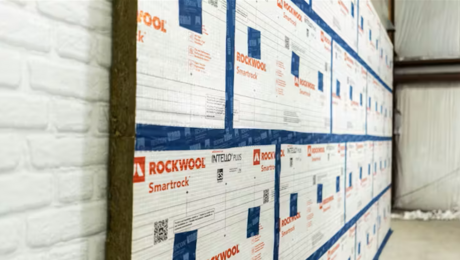
Rigid mineral wool has been a popular choice of insulation for several years now. One of the manufacturers of the product, Rockwool, promotes its rigid mineral wool product (ComfortBoard) for use above and below grade, both inside and outside a structure. Rockwool recently joined forces with Pro-Clima, a European manufacturer of water-management and air-sealing products to produce a new insulation and water-vapor management product designed to be installed on the interior side of masonry and concrete wall assemblies, including buildings constructed of brick, block, CMU, tilt walls, and poured or cast-in-place walls, and in traditional basements built from CMUs and poured concrete. This new product is called Smartrock.
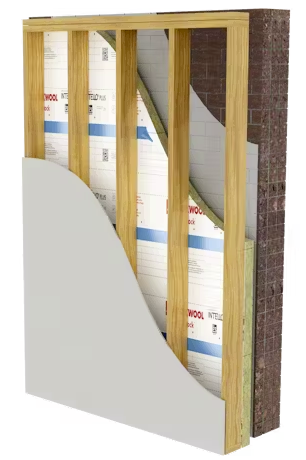
The rigid Rockwool insulation product (which is vapor open, meaning water vapor easily passes through) incorporates Intello Plus as an integrated component of the finished product. Intello Plus is a Class II vapor retarder (also known as a smart or responsive vapor retarder).
There are seasonal differences in how Smartrock performs. Cold, outdoor air holds minimal water vapor, but the air inside our homes during the heating season often holds higher amounts of water vapor. This creates an outward vapor drive condition—inside moisture naturally wants to get to the dryer outside. When this condition exists, Smartrock acts as a low Class II vapor retarder, limiting the outward vapor drive of water vapor into the wall assembly, where it can accumulate and cause damage.
Conversely, when there is a higher humidity inside the wall assembly (from wetting of the masonry or concrete wall, either by a bulk water event or by higher outside humidity levels) and a lower humidity inside a home, the vapor drive is inward. To prevent accumulation or trapping of the water vapor inside the wall assembly, the product changes to a Class III vapor retarder, allowing the moisture to dry into the structure.
Intello is also a good air barrier, restricting the movement through the product when seams and penetrations are appropriately taped. The performance of Intello as an air barrier means that damp indoor air cannot move by way of air currents to a colder masonry wall. This reduces the risk of condensation on the surface of the concrete. The Intello does need to be taped at all seams and penetrations, including the fasteners used to hold the product on the wall. Smartrock should also be sealed at the floor and top plate along with all corners.
One additional feature of the product is that it is a Class A fire-rated material, tested in accordance with ASTM E84.
The Smartrock product is available in 2-in. to 5-in. thicknesses in half-inch increments. Listed R-value is R-4.2 per inch, meaning the 5-in. Smartrock is R-22. The Intello Plus has a listed permeance of 0.09 to 6.03 depending on the relative humidity of the mineral wool insulation. So we have a fibrous insulation with a factory-applied smart vapor retarder that will allow moisture through the assembly under challenging conditions.
The product comes in 2-ft. by 4-ft. panels that require a mechanical attachment to the masonry wall. Rockwool and 475 High Performance Building Supply have a good video showing several methods for attachment to the wall. You can also view the Smartrock data sheet and the ICC evaluation report.
Innovation in the building products we use for insulating homes and other structures is moving toward simpler applications by combining multiple products into one. The creation of Huber’s Zip-R (and other nail-base insulations), Henry’s VPTech (insulation and self-adhered WRB in one), and now Smartrock all look to speed construction and hopefully lower labor costs.
GBA editor Randy Williams is a recovering general contractor who performs energy auditing and building investigations in Grand Rapids, Minn. He teaches and speaks about building science topics around the country. Photos by the author unless otherwise noted.
Weekly Newsletter
Get building science and energy efficiency advice, plus special offers, in your inbox.