
Blog
Practical constraints to following expert advice re: heat pumps – GreenBuildingAdvisor
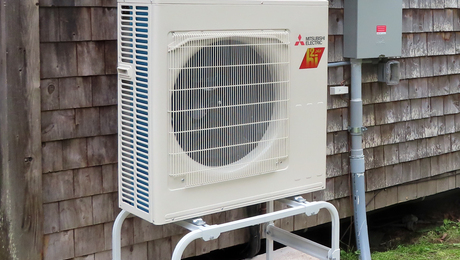
Hi and thank you to everyone who has kindly responded to my recent queries re: heat pump install at my existing 3-story house on border of zone 5/6 (VT-MA). Im posting again because it seems, for reasons described below, that I am between a rock and a hard place. Any input–especially from users and/or installers of multizone ductless heat pumps–will be greatly appreciated.
Floor plan is spread out and amorphous with many bedrooms and family members who, unfortunately, are dead set against small, high up wall openings or sleeping with doors open. We are fully gutted and, in theory, would be a great candidate for a ducted heat pump system. Reality check: I cannot find any hvac contractor in my area who is willing to quote a sensibly sized ducted system at my house. They are turned off because, in the words of one contractor, the house, despite being fully gutted, “has a highly complex roof system, complex (if not superfluous) framing, and very limited space for ductwork and air handlers”. I should note that two licensed MEs visited my house in its current gutted state and were flummoxed over how to duct it.
I recently uploaded my floor plan to this forum, and an expert member kindly marked it up with a potential scheme for ducting. I showed their suggestion to two local installers (there arent many in this rural community), neither of whom was willing to provide a quote for execution. Another nearby contractor (“Mitsubishi diamond”) provided a “no thank you” quote for a different, five-compressor ducted system that was grossly oversized per manual J I completed in Wrightsoft (yes: *ducted* but with FIVE different outdoor compressors). Not surprisingly, quote involved a lot of custom-made ductwork. Which I feared it would after measuring spaces between framing and inputting cfm’s for each room into ductulator app. I looked into hydronic and geothermal but cannot find anyone around here to install.
Given these constraints, it looks like we will need to either continue heating with fossil fuels and wood (as we currently do, using an ancient, rickety oil furnace and new, EPA log burning insert) or be “forced” to a ductless heat pump system, which most local hvac contractors have expressed eagerness to install (in total contrast to their stance on a ducted system).
Many kind GBA members have warned against the drawbacks of multizone ductless heat pumps but, given floor plan, I dont see multiple single zone units as an option. Im now trying to gather as much as info as possible on how I can mitigate some well-known cons of multizone ductless, since it’s looking like other types of system may be off the table.
For certain, I will need *at least* two compressors given layout of house and number of “closed off” rooms requiring heat (eleven!). Our plan is to use heat pumps exclusively for heat, never for cooling. We will likely supplement the heat by burning logs, since my brother harvests and delivers cordwood for a living, and we are very pleased with how well our EPA log burner heats an (admittedly small) area of house. We accept that ductless heat pumps cannot dehumidify, so we would need alternate equipment if moisture were to rise above an “acceptable” level. Finally, we do not want to choose equipment based on requirements of any rebate program, as we know of homeowners who ended up with improperly sized or configured equipment because of the at-times arbitrary restrictions of these programs.
First question:
I was thinking to put each compressor on a different service panel (we have two 200-amp mains) so that if one panel or compressor fails, at least the other can still heat its corresponding rooms. Prudent…or not?
Second question:
One kind GBA member suggested overcommitting outdoor unit. So I was thinking that, if my indoor units are rated at 6K+6K+6K+6K+9K+9K (ie, total rated capacity 42K), to select a 36K compressor instead of 42K. The Mitsubishi 3 ton hyper heat compressor shows max heating capacity of 42K despite being rated 36K. Does this level of “overcommitment” seem acceptable ?
Third question:
It’s unfortunate that Mitsubishi (the heat pump manufacturer with best representation where I live) does not make a smaller capacity multizone-compatible head, but their heads start at rated capacity of half ton. And submittal sheet shows true heating capacity on these as 7200 btu. Because of our roof design, it would be very tough to install a ceiling or wall unit in some of the bedrooms; really, the only indoor unit configuration that physically fits in these spaces is floor mount, the smallest of which has rated capacity of 9K and actual heating capacity of 11K (per submittal sheet). For super small rooms (eg, our ancient bathrooms), i can heat with ceiling infrared panels or baseboard. But I suspect some rooms may be too large to heat with infrared or resistance, yet too small to put a heat pump head in. What is your suggestion for these “kinda small” rooms, assuming they are mostly closed off yet people do indeed spend time in them ? Oh and I should clarify: any room that opens to an adjacent room (without significant human protest), will indeed be left this way.
Fourth question:
I believe I have understood readers on this forum to suggest, for a given compressor, setting all zones to the same temperature; ie, do not heat one bedroom to 60 F while heating the adjacent bedroom (different head but same compressor) to, say, 75 F. At a minimum, make sure all zones are “on” and shooting for same temp at the same time. Have I correctly understood this advice? Luckily, I think this suggestion should be easy to implement from a human behavior perspective. But I dont know how easy it will be for the equipment to keep a bedroom with, say, large windows, at the same temp as an adjacent bedroom that happens to have fewer or smaller windows.
Fifth question:
For different reasons, at least two GBA readers have asserted that the Mistubishi hyper heat compressors with “SM” in the model number are superior to the older (and smaller) compressors with “C” in the model number. With this in mind, which of the following multi-compressor ductless setups is likely to be “less problematic” in terms of reliability, user comfort, equipment lifespan ? Assume whole house heating load of 70K. This value could change depending on blower door result after we finish some planned air sealing, but unfortunately it will not be practical for us to complete said air sealing until the warm New England months.
Setup A (3 compressors, none of which is “smart multi”):
MXZ-2C20NAHZ2 compressor (max heating capacity 22K) serves indoor units with rated capacities of 6K, 9K, 9K.
MXZ-2C20NAHZ2 compressor (max heating capacity 22K) serves indoor units with rated capacities of 6K, 6K, 6K.
MXZ-3C30NAHZ2 compressor (max heating capacity 28600) serves indoor units with rated capacities of 6K, 6K, 6K, 9K, 9K.
versus
Setup B (2 compressors, each of which is smallest “smart multi” available):
MXZ-SM36NAMHZ (max heating capacity 42000K) serves indoor units with rated capacities of 6k,6k,6k,9k,9k
MXZ-SM36NAMHZ (max heating capacity 42000K) serves indoor units with rated capacities of 6k,6k,6k,6K, 9k,9k
Thank you for your time and any input. I have taken to heart everyone’s advice but it seems that, for practical reasons, I may have no option other than ductless multizone.